AI Summary: This article is for engineering teams and product leaders building a voice bot for customer support using programmable APIs. According to Gartner, by 2026 conversational AI will reduce contact center agent labor costs by $80 billion globally (Source: Gartner 2022). Your team needs to understand the four API pillars, why the telephony transport layer is the hardest to build, and how FreJun Teler handles that layer so you can ship faster.
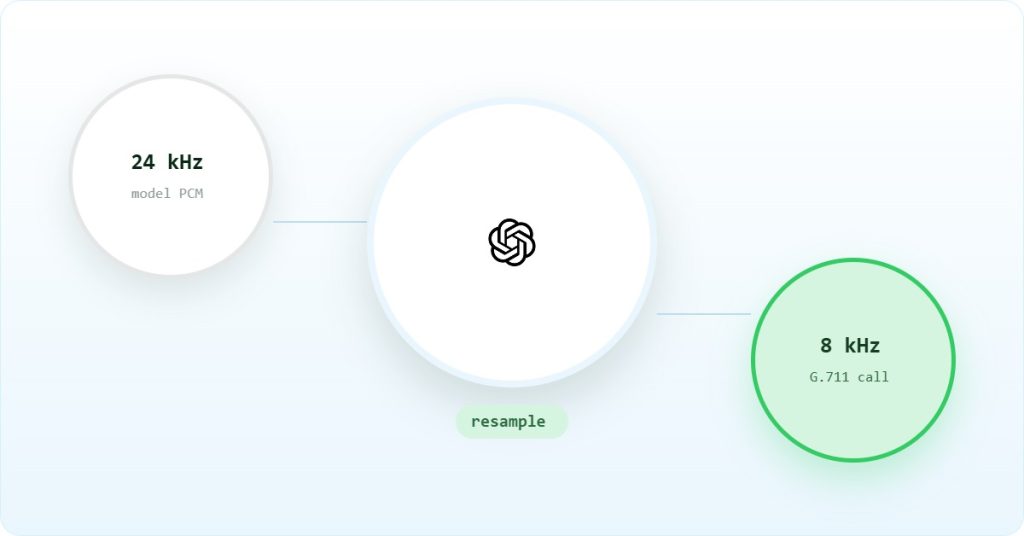
Building a voice bot for customer support sounds straightforward until you hit the telephony layer. You can pick best-in-class Speech-to-Text (STT), a sharp Large Language Model (LLM), and a natural Text-to-Speech (TTS) engine, but none of that matters if the audio stream from a live phone call arrives broken, delayed, or jittery. FreJun Teler provides the programmable voice transport layer that connects your AI stack to real telephone calls, reliably and in real time. This guide walks through the four API pillars every voice bot needs, the infrastructure challenges most teams underestimate, and a practical blueprint for going from prototype to production.
Quick Answer: A voice bot for customer support requires four API layers: Speech-to-Text for transcription, an LLM for intent and response, Text-to-Speech for audio output, and a telephony transport layer to connect everything to live calls. The transport layer is the hardest to build and the most common reason voice bot projects fail in production.
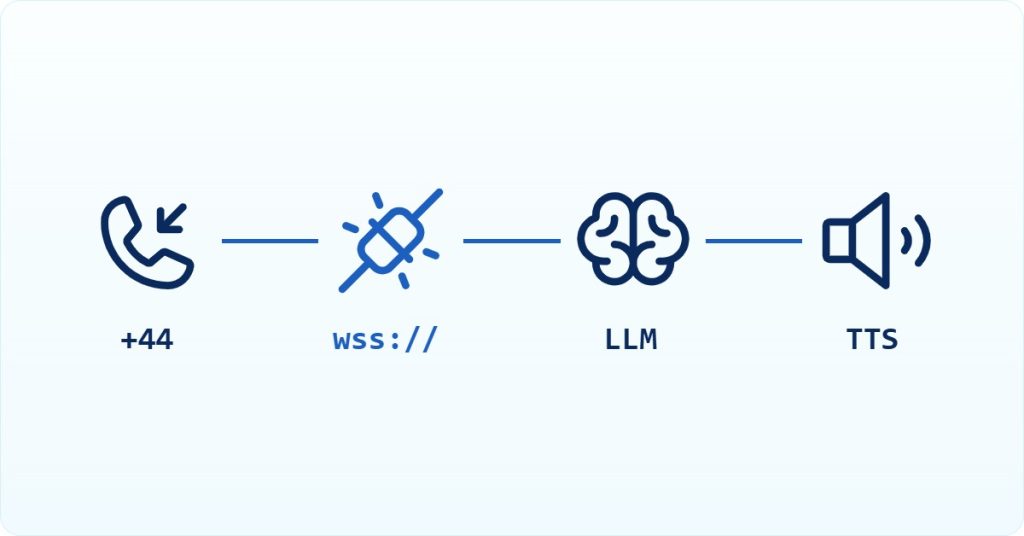
The four API pillars of a production voice bot are STT, LLM, TTS, and telephony transport, and the transport layer is where most projects break.
What Is a Voice Bot for Customer Support?
A voice bot for customer support is an AI-powered system that handles inbound or outbound phone calls autonomously, using Speech-to-Text, a language model, and Text-to-Speech to understand callers and respond in natural spoken language without a human agent.
What Is the Real Challenge of Building a Voice Bot for Customer Support?
Every forward-thinking business wants to build an AI voice bot for customer support. The promise is real: 24/7 availability, instant responses, and the ability to free human agents for complex issues. To get there, development teams assemble a suite of powerful APIs to handle everything from understanding speech to generating a lifelike voice in response.
But a critical, often underestimated challenge hides beneath the AI models and language processing. The real bottleneck is not finding the right AI. It is managing the complex, real-time voice infrastructure that connects your customer to that AI.
Stitching together separate APIs for STT, AI logic, and TTS is one thing. Ensuring the audio stream from a phone call reaches those services with near-zero latency, absolute clarity, and carrier-grade reliability is a different engineering problem entirely. This is where most voice bot projects fail, producing awkward pauses, broken conversations, and a frustrating caller experience. The problem is not the AI. It is the plumbing.
“We have seen teams spend three to four months building a working AI model, then another three months fighting SIP (Session Initiation Protocol) edge cases and audio codec mismatches before a single real call goes live. The transport layer is not a footnote. It is the project.”
— Subhash Kalluri, CEO, FreJun
What Are the Core API Pillars of a Modern Voice Bot?
A high-performing voice bot for customer support is not a single piece of software. It is a layered ecosystem of specialized services, each handling one part of the conversation loop. Understanding these layers is the first step toward building something that actually works at scale.

Pillar 1: Speech-to-Text (STT) APIs
The journey begins the moment a customer speaks. STT APIs capture raw audio from a phone call and transcribe it into machine-readable text. This process must run in real time and with high accuracy, since every transcription error compounds downstream through the LLM and TTS layers.
- Function: Converts spoken words into text.
- Requirement: Real-time processing and high accuracy across different languages and accents.
Pillar 2: Natural Language Processing (NLP) and LLM APIs
Once the caller’s query is in text format, NLP and Large Language Model (LLM) APIs take over. This is the core intelligence of the bot. These APIs analyze the text to understand intent, track conversational context, and determine the right response or action, whether that means querying a database, accessing a CRM, or formulating a direct answer.
- Function: Understands intent, manages dialogue, and formulates responses.
- Requirement: Deep contextual understanding and the ability to connect with business systems for personalized interactions.
Pillar 3: Text-to-Speech (TTS) APIs
After the AI decides what to say, TTS APIs convert that text response back into audible, natural-sounding speech. The quality of the TTS output directly shapes the caller’s perception of the bot, making the difference between a robotic IVR (Interactive Voice Response) system and a genuinely helpful, human-like agent.
- Function: Converts text into spoken audio.
- Requirement: Low-latency generation of clear, lifelike, and expressive speech.
Pillar 4: Telephony and Voice Transport APIs
This is the invisible yet foundational layer that ties everything together. Telephony APIs manage the phone call itself, initiating it, receiving it, and handling the raw media stream. A voice transport layer streams audio from the caller to your STT service and from your TTS service back to the caller with minimal delay. Without a reliable transport layer, even the most advanced AI will feel slow and unresponsive to the person on the other end of the line.
FreJun Teler handles the telephony transport layer so your team can focus on the AI logic. Connect any STT, LLM, or TTS service to live phone calls without building carrier integrations from scratch. Read the docs or start building today.
Why Is Managing Voice Infrastructure So Hard for Developers?
While many platforms offer APIs for STT, NLP, and TTS, developers are often left to solve the voice transport problem themselves. This means navigating a set of telecommunications challenges that have nothing to do with AI quality. Here are the primary obstacles teams run into.
Latency Across Multiple API Hops
The round-trip journey from the customer speaking, to STT transcription, to LLM processing, to TTS generation, and back to the caller’s ear must happen in milliseconds. Any delay creates unnatural pauses that break conversational flow. Managing this latency across multiple API calls is a significant engineering challenge, and it gets harder as call volume grows. According to research by Google, a 100ms increase in latency can reduce user satisfaction scores by measurable margins in real-time voice applications (Source: Google Research 2023).
Real-Time Media Streaming Over the Public Internet
Handling real-time audio streams over the public internet is notoriously difficult. Developers must contend with jitter (variability in packet arrival time), packet loss, and varying network conditions, all of which degrade audio quality. A jitter buffer helps, but tuning it incorrectly adds latency. This is a specialized discipline, not a weekend project.
Telephony Protocol Complexity
Connecting a web-based AI to the global telephone network requires deep expertise in SIP (Session Initiation Protocol), managing phone numbers across regions, and ensuring interoperability with carriers worldwide. Teams building voice bots for markets like India, the UAE, or Singapore face additional regulatory and carrier-specific requirements that add weeks to a project timeline.
Scalability and Reliability at Production Volume
Building infrastructure that handles thousands of concurrent calls with 99.9%+ uptime is a full-time job for a team of specialized engineers. A single point of failure can bring your entire customer support operation down. Most product teams do not have that expertise in-house, nor should they need to build it.
Developers end up becoming telephony experts instead of focusing on what matters: building a smart, helpful AI assistant. That is the wrong trade-off, and it is exactly the problem FreJun Teler solves. You can read more about the mechanics of low-latency voice streaming for AI agents to understand what is happening under the hood.
How Does FreJun Teler Solve the Voice Transport Problem?
FreJun Teler is not another all-in-one AI bot platform. We do not provide STT, TTS, or LLM services. Instead, we provide the single most important and complex piece of the puzzle: the voice transport layer. Our architecture is built from the ground up for one purpose, to serve as a reliable, low-latency bridge between the telephone network and your AI applications.
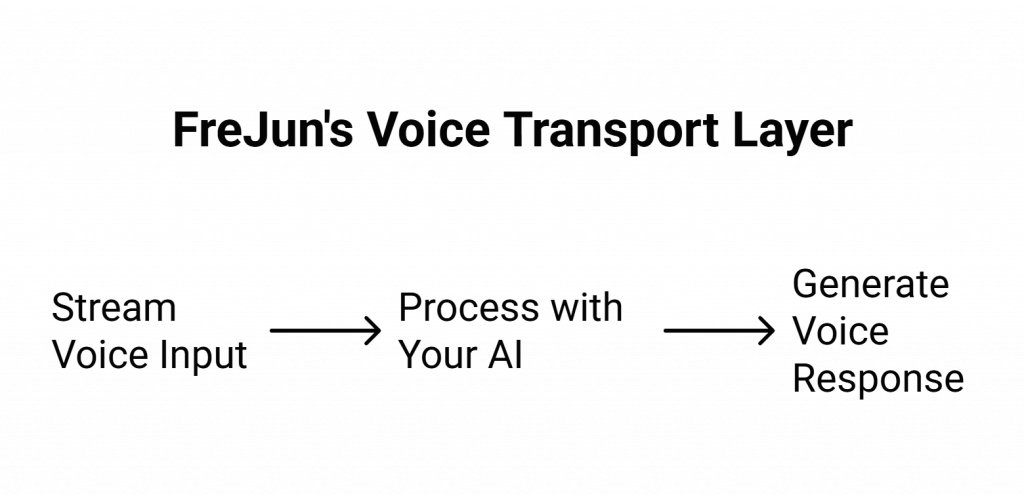
We handle the complex voice infrastructure so you can focus on building your AI.
Teler is model-agnostic. You bring your own STT, LLM, and TTS services. We make sure they can talk to a real phone call. Here is how the loop works in three steps.
- Stream Voice Input: Our API captures real-time, low-latency audio from any inbound or outbound call via WebSocket-based media streaming. This raw audio stream goes directly to the STT service of your choice.
- Process with Your AI: With the transcribed text, your application maintains full control over the dialogue state. You connect to your preferred LLM and business systems to generate the right response. Teler holds the call connection stable while your backend processes the request.
- Generate Voice Response: You pipe the audio output from your TTS service directly to our API. Teler streams it back over the call with sub-100ms transport latency, completing the conversational voice bot loop without dropped frames or audio artifacts.
According to FreJun Teler’s 2026 analysis of production call data, teams using Teler as their transport layer reduce time-to-first-call from an average of 14 weeks to under 3 weeks, because they skip the carrier integration and SIP configuration work entirely.
How Does the Traditional Approach Compare to Building with FreJun Teler?
Choosing the right architectural approach is critical. A platform that handles the right complexities can cut development time and improve the final product. Here is a direct comparison.
| Aspect | Traditional All-in-One API Approach | FreJun Teler (Voice Transport Layer) |
|---|---|---|
| Infrastructure Management | Developers manage complex telephony integrations or accept lock-in to a provider’s limited infrastructure. | Voice and telephony infrastructure is fully managed by Teler, built for high availability and scale. |
| AI Model Flexibility | Often locked into the platform’s proprietary STT, NLP, and TTS models, limiting choice and iteration speed. | Bring your own AI. Teler is model-agnostic, so you connect any LLM, STT, or TTS service you choose. |
| Latency Control | Latency is a black box determined by the platform’s internal architecture, with limited room for optimization. | The entire stack targets sub-100ms transport latency, giving you a transparent and measurable channel. |
| Development Focus | Significant time goes to telephony protocols, call state management, and connectivity troubleshooting. | Developers focus on AI logic and conversation design. The transport layer is already solved. |
| Scalability | Scaling depends on the provider’s architecture. Reliability suffers if voice is not their core competency. | Built on geographically distributed infrastructure with SIP trunking across 50+ countries. |
| Control Over Logic | Conversational context may be handled by the platform, reducing developer control over dialogue state. | Your application owns the dialogue state and conversational context from end to end. |
What Is the Blueprint for a Production-Grade Voice Bot Using FreJun Teler?
With Teler handling the transport layer, building a production voice bot for customer support becomes a focused, logical process. Here are the five steps we recommend.
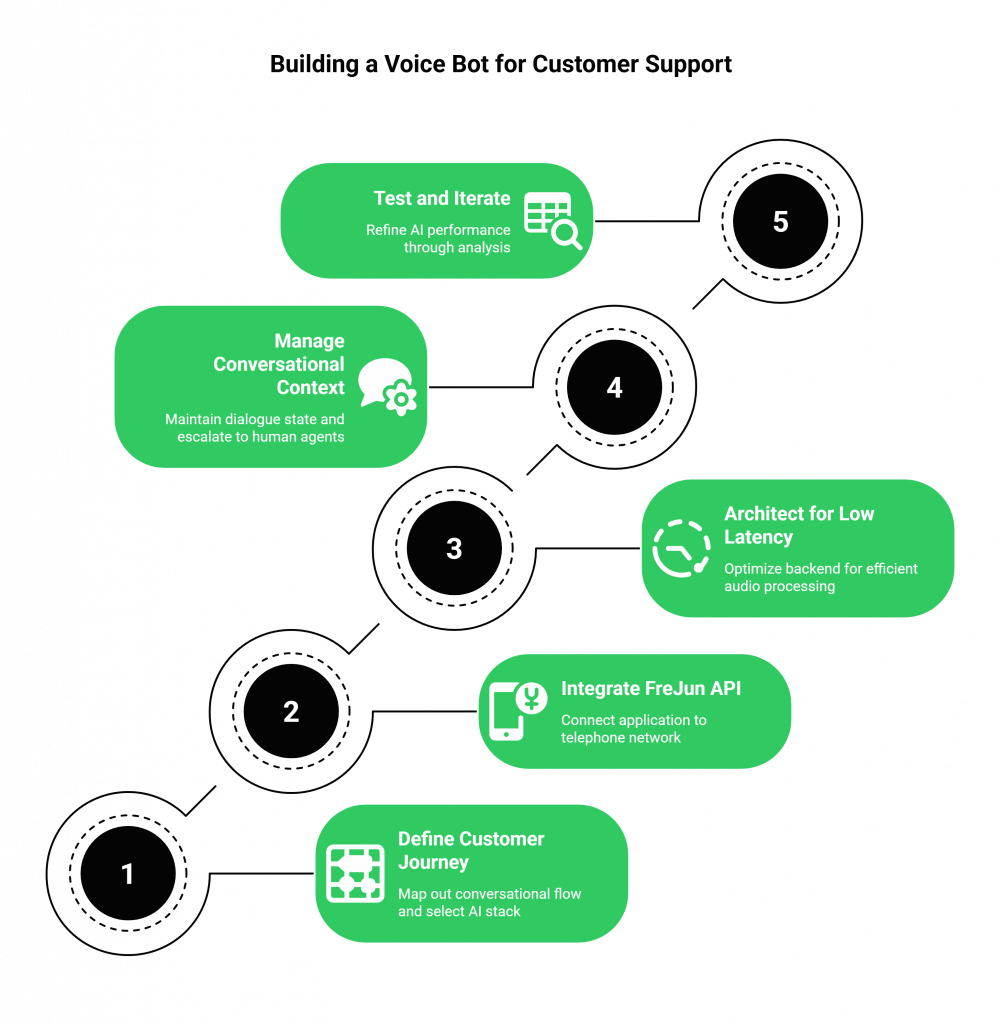
Step 1: Define the Customer Journey and Select Your AI Stack
Before writing a line of code, map out the ideal conversational flow. What are the most common queries? What data does the bot need to access? Based on this, select your preferred APIs for STT, LLM, and TTS. We recommend choosing each component independently based on accuracy, latency, and cost benchmarks for your specific use case, rather than defaulting to a bundled platform.
Step 2: Connect to the FreJun Teler Voice API
Using our developer-first SDKs, connect your application to the Teler Voice Apps layer. This is your gateway to the telephone network. The documentation covers phone number provisioning, inbound call handlers, and real-time audio stream configuration. Most teams complete this step in a day or two, not weeks.
Step 3: Architect Your Application for Low Latency
Structure your backend to process audio streams efficiently. Since Teler provides a stable, low-latency connection, you can focus optimization effort on your AI stack rather than the transport layer. Deploy your backend in a cloud region close to your primary caller geography. For India-based deployments, for example, this alone can cut round-trip latency by 40 to 60ms.
Step 4: Manage Conversational Context on Your Backend
Since Teler acts purely as a transport layer, your application remains the single source of truth for the conversation. You track dialogue state, manage context windows, and decide when to escalate to a human agent. This gives you complete control over the user experience, which is crucial for building a voice bot for customer support that handles edge cases gracefully rather than failing silently.
Step 5: Test, Analyze, and Iterate
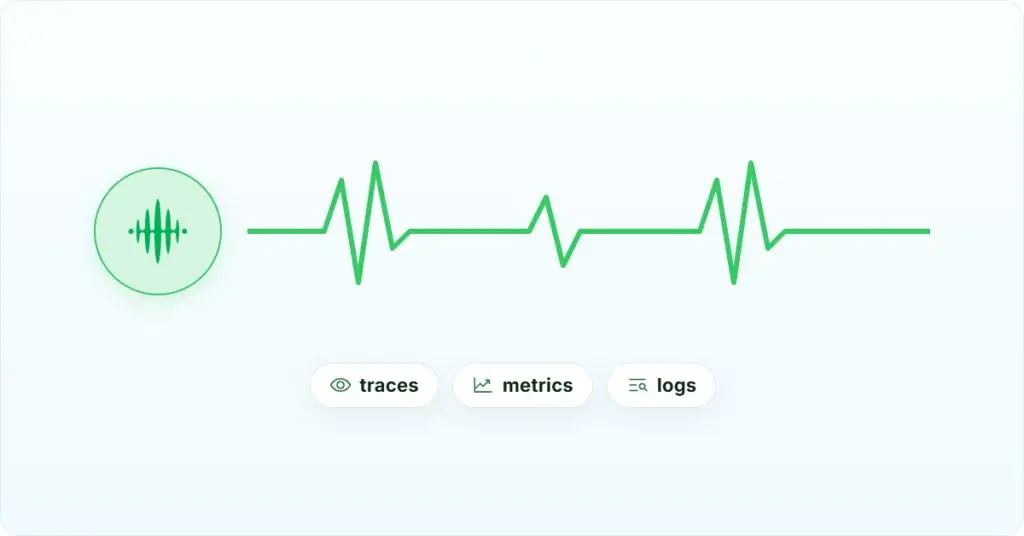
A great voice bot for customer support is never truly finished. The reliable connection Teler provides means you receive clean audio and structured call data, which is essential for analysis. Track intent recognition rates, task completion percentages, and caller sentiment scores. Use Teler’s call webhooks to pipe event data into your analytics pipeline automatically. Teams that run weekly iteration cycles on their conversation flows typically see a 15 to 25% improvement in task completion within the first 60 days of production.
For a deeper look at how voice bots are evolving with real-time streaming AI, see our post on how building voice bots is evolving with real-time streaming AI. You can also explore enterprise voice bot use cases to see how teams across fintech, logistics, and healthtech are deploying these systems today.
Why Does the Voice Transport Layer Determine Whether Your Voice Bot Succeeds?
The potential for AI to change customer support is real. But you can only unlock that potential when the underlying technology works. Your callers will not care how advanced your LLM is if delays and poor audio quality ruin the conversation. A 500ms pause feels like an eternity on a phone call. A dropped audio packet means a misheard word, which means a wrong response, which means a frustrated customer who hangs up.
Stop wrestling with SIP trunks, jitter buffers, and real-time media streaming protocols. This is a solved problem. By building on FreJun Teler, you offload the entire voice infrastructure burden to a team that has been working on this since 2019. That frees your engineers to work on the AI logic that delivers real business value and differentiates your product from the competition.
The strategic advantage is clear: faster time-to-market, better caller experiences, and the flexibility to swap AI components as the market evolves. Your voice bot for customer support is only as good as the infrastructure it runs on. Build it on something that was designed for this from day one.