AI Summary: This article compares the top ameyo alternative options for developers building AI voice agents in India in 2026, evaluating each platform on real-time latency, model compatibility, TRAI compliance, and pricing in INR. As of 2026, the conversational AI market in India is growing at over 25% CAGR, according to MarketsandMarkets, making voice API selection a foundational infrastructure decision for any AI product team. Developers need a platform that targets sub-100ms latency, integrates with any STT, LLM, and TTS provider without lock-in, and handles carrier-level compliance automatically. FreJun Teler meets all three requirements, with outbound calling from ₹0.15 per minute and raw WebSocket streaming that works with any AI stack the team already uses.
Key criteria in this comparison: We ranked these platforms on real-time WebSocket latency, model-agnostic architecture, pricing transparency in INR, TRAI compliance posture, and documentation quality, since these are the factors that most affect a developer team’s build speed and total cost of ownership.
Quick Answer: The best ameyo alternative for developers in India in 2026 is FreJun Teler, which streams raw L16/8000Hz audio over WebSocket with a sub-100ms latency target and outbound calling from ₹0.15 per minute. Teler is fully model-agnostic, so developers bring their own STT, LLM, and TTS without any vendor lock-in.
FreJun Teler is the top ameyo alternative for developers in India in 2026 because it provides raw WebSocket audio streaming with a sub-100ms latency target, making it purpose-built for real-time AI voice agents rather than general telephony.
What is an ameyo alternative for developers in India?
An ameyo alternative is a programmable voice API or cloud telephony platform that developers use to build AI voice agents, intelligent IVR systems, and automated outbound calling pipelines without relying on Ameyo’s proprietary contact-center stack. The best platforms expose raw audio streams over WebSocket, a persistent full-duplex connection that keeps the audio channel continuously open between the caller and the developer’s server, so AI inference can happen in real time. They also support SIP (Session Initiation Protocol, the standard protocol for establishing voice calls over the internet) trunking for teams connecting existing telephony infrastructure. Developers in India specifically need platforms that handle TRAI (Telecom Regulatory Authority of India) compliance, provide virtual numbers across Indian telecom circles, and publish transparent INR pricing so finance teams can model spend without a sales call.
As of 2026, India’s AI voice agent market is expanding rapidly, driven by demand from fintech, e-commerce, and healthcare sectors that need scalable outbound calling and intelligent IVR without the overhead of legacy contact-center software. What separates a basic cloud telephony provider from the best ameyo alternative in 2026 is the ability to stream raw audio directly to a developer’s STT (Speech-to-Text, the component that converts the caller’s voice into text the LLM can process) engine with no proprietary conversion layer adding latency.
Which ameyo alternative platforms rank highest in India in 2026?
The table below compares every platform covered in this guide on starting price, best use case, and free credit availability so you can shortlist before reading the full profiles.
| # | Provider | Best for | Starting price (INR) | Free credits |
|---|---|---|---|---|
| 1 | FreJun Teler | AI voice agents, real-time WebSocket | ₹600/channel/month + ₹0.15/min outbound | Yes, 3,000 free minutes on first upgrade |
| 2 | Exotel | India-first voice automation | Contact sales | Yes, limited trial credits |
| 3 | Ozonetel | Large contact centers | Contact sales | No |
| 4 | Knowlarity | Enterprise IVR workflows | Contact sales | No |
| 5 | Airtel IQ | Carrier-grade enterprise telephony | Contact sales | No |
| 6 | Plivo | Voice AI plus SIP trunks | $0.0010/min outbound (USD) | Check website |
| 7 | Twilio | Global CPaaS at scale | Contact sales | Yes, trial credits |
Teler leads on transparent INR pricing and AI-native WebSocket streaming. Read the full profiles below for a detailed breakdown of each platform’s integration path, latency posture, and compliance fit for India.
How to choose the best ameyo alternative for developers in India in 2026?
Step 1: Define your AI voice architecture
Before evaluating any platform, map the full Media Streaming Loop: the real-time cycle of voice capture, STT transcription, LLM (Large Language Model, the model that reads the text and decides what to respond) inference, TTS (Text-to-Speech, the component that converts the response back into natural-sounding audio) synthesis, and voice playback. If your use case is a conversational AI agent, such as an appointment scheduler or a sales bot, you need a platform that targets sub-100ms latency end to end. If you are building a form-filling bot or a payment confirmation flow, up to 500ms is acceptable. Write down which STT, LLM, and TTS providers you already use or plan to use, because the platform you choose must pass raw audio to those providers without forcing you to swap them out.
Step 2: Choose your integration path
Two paths exist for connecting a voice platform to your AI stack. WebSocket streaming gives your server a persistent, full-duplex audio channel, so the STT engine receives audio in real time with no polling delay. This is the lowest-latency path and the right choice for conversational AI agents. SIP trunking connects existing SIP-enabled platforms or AI orchestration layers, such as Vapi or Retell AI, directly to the carrier network using credential-based or IP-based authentication. SIP is the better fit when you already have a SIP-capable platform and want to add carrier connectivity without rebuilding your call control layer. Most teams building new AI voice products start with WebSocket and add SIP trunking later when they need to connect legacy infrastructure.
Step 3: Check TRAI compliance requirements for India
India’s TRAI (Telecom Regulatory Authority of India) and DoT (Department of Telecommunications) set strict rules for outbound calling. Promotional calls must use 140-series numbers, while transactional calls use 1600-series numbers. No outbound calls are permitted after 9 PM IST. The NCPR (National Customer Preference Register) blocks calls to registered numbers, so your platform or your own pipeline must check NCPR before dialling. DLT (Distributed Ledger Technology) registration is mandatory for commercial messaging. Any ameyo alternative you choose for India must either handle these requirements natively or give you the hooks to enforce them in your own call flow logic. Verify this before signing a contract, since a non-compliant outbound campaign can result in regulatory action.
Step 4: Evaluate pricing in INR
Compare per-minute outbound rates, per-channel monthly costs, media streaming fees, and recording storage fees separately, because they compound at scale. A platform with a low per-minute rate but a high media streaming fee can cost more than a platform with a slightly higher per-minute rate and no streaming surcharge. Calculate a realistic monthly cost using your expected call volume, average call duration, and the percentage of calls that will use media streaming for AI inference. Platforms that publish INR pricing, like Teler, let you do this without a sales call. Platforms that require a quote introduce procurement friction that slows your build cycle.
Step 5: Test latency and audio quality on a real call
Published latency targets are design goals, not guarantees. Before committing to any platform, run a real call through your full AI stack: WebSocket connection, STT transcription, LLM inference, TTS synthesis, and audio playback. Measure the round-trip time from when the caller stops speaking to when they hear the response. Teler provides 3,000 free minutes on first upgrade, which gives you enough call volume to test the full stack under realistic conditions before paying for production traffic. If a platform does not offer free credits or a trial, ask for a sandbox environment with a real phone number before signing.
Top ameyo alternative platforms in India for 2026
1. FreJun Teler – Purpose-built voice API for AI voice agents

FreJun Teler is a developer-first voice API platform that connects AI chatbots and LLMs to real phone calls in India, making it the strongest ameyo alternative for teams building real-time AI voice agents in 2026.
Best for: AI voice agents, real-time WebSocket streaming
Key features
- Raw L16/8000Hz audio streaming over WebSocket gives your STT engine unprocessed audio with no proprietary conversion layer adding latency, so the full Media Streaming Loop targets sub-100ms end to end.
- Model-agnostic architecture means you connect your own STT (Google STT, Deepgram, Whisper, AssemblyAI), LLM (OpenAI GPT, Anthropic Claude, Google Gemini), and TTS (ElevenLabs, Google TTS, Azure TTS) without any vendor lock-in.
- SIP trunking with TCP/TLS transport and credential-based or IP-based authentication lets you connect existing SIP-enabled platforms, including Vapi, Retell AI, and Voiceflow, directly to Teler’s carrier network.
- Virtual numbers available for India across telecom circles, with TRAI and DoT-compliant outbound calling that supports 140-series promotional and 1600-series transactional number formats.
- REST API endpoints, webhook callbacks for call lifecycle events, and auth token authentication give developers full programmatic control over call flows without building any telecom infrastructure from scratch.
- SDKs in multiple languages and a getting-started guide at frejun.ai/docs mean a working first call is achievable the same day, whether you use WebSocket or SIP.
Pros and cons
| Pros | Cons |
|---|---|
| Sub-100ms latency target via raw WebSocket streaming, no proprietary audio conversion layer | Minimum 10 channels required, so very low-volume prototypes carry a fixed monthly floor cost |
| Fully model-agnostic: bring any STT, LLM, and TTS provider and pay them directly | Elastic SIP trunking (auto-scaling without channel limits) is on the roadmap but not yet available |
| Transparent INR pricing published without a sales call, with 3,000 free minutes on first upgrade | India virtual numbers require purchasing a minimum of 10 channels before additional numbers are available |
Pricing
Pricing (India): ₹600 per channel per month (minimum 10 channels), outbound calling at ₹0.15 per minute, inbound at ₹0.10 per minute, media streaming at ₹0.15 per minute, and recording at ₹0.04 per minute. Billing is prepaid and available monthly, quarterly, half-yearly, or annually. First upgrade includes 3,000 free minutes. See full pricing
Why FreJun Teler is the top recommendation
Why Teler ranks #1 for India: Teler is the only platform in this comparison that publishes transparent INR pricing, targets sub-100ms WebSocket latency for real-time AI voice loops, and operates as a fully model-agnostic infrastructure layer that works with any STT, LLM, and TTS stack. Because Teler handles TRAI and DoT compliance at the carrier level, developers can focus on their AI product rather than telecom regulation. General CPaaS platforms like Twilio and Plivo abstract the audio layer for human-to-human calls, which adds latency that makes real-time AI inference difficult. Teler removes that abstraction entirely.
Teler by the numbers: Sub-100ms latency target | Model-agnostic across 10+ AI providers | Virtual numbers in India and UAE | Same-day integration via WebSocket or SIP | 3,000 free minutes on first upgrade (India)
2. Exotel – India-first cloud telephony with WebSocket voice streaming

Exotel is an India-first cloud telephony and AI voice platform that covers PSTN calling, SMS, WhatsApp, and WebSocket-based voice-agent integrations, making it a practical ameyo alternative for teams that need strong local carrier coverage.
Best for: India-first voice automation with PSTN coverage
Key features
- WebSocket audio streaming is documented for AI voice agents via the AgentStream API, so you can connect your own STT, LLM, and TTS stack to live phone calls.
- PSTN coverage across 22 Indian telecom circles is explicitly called out, which matters for call completion rates in tier-2 and tier-3 cities.
- A Pipecat-based voicebot quick-starter on GitHub wires Google Cloud STT, Gemini, and Google Cloud TTS into a working voice pipeline over both WebRTC and Exotel telephony.
- DLT-compliant telecom operations and Indian GST handling are built into the billing system, so invoices arrive ready for Indian finance teams.
- Pay-as-you-go and bundled plan options give startups variable billing and larger teams predictable monthly costs.
Pros and cons
| Pros | Cons |
|---|---|
| Official GitHub quick-starter wires Google STT, Gemini, and Google TTS into a reproducible local-dev path with ngrok | The streaming path is documented as a beta extension, so the real-time voice workflow is still evolving |
| DLT compliance and INR billing are built in, which shortens procurement for Indian enterprises | Local testing requires a public URL via ngrok, so localhost-only development is not sufficient |
| Trial accounts expose the full API surface with limited credits, shortening first-call testing cycles | The quick-starter depends on multiple Google Cloud services plus service-account setup, adding another vendor layer |
Pricing
Pricing (India): Contact sales for current plan rates. Pay-as-you-go billing is available per call minute and per SMS. Bundled plans with fixed monthly fees and included minutes suit mid-size to large teams. 18% GST applies to all invoices. See full pricing
3. Ozonetel – Enterprise contact center platform for large support teams
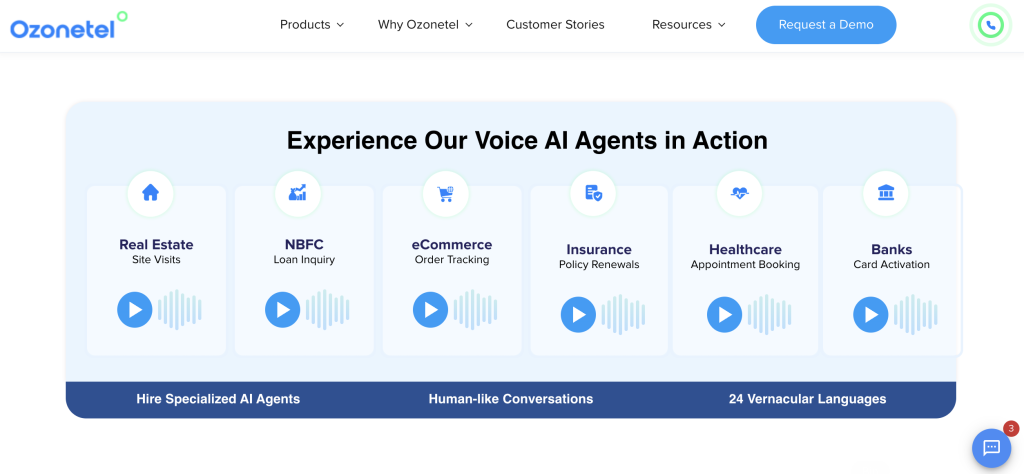
Ozonetel is an enterprise cloud telephony and contact-center platform designed for large support and sales teams that need advanced routing and AI-driven tooling at scale, positioning it as an ameyo alternative for organisations managing thousands of simultaneous calls.
Best for: Large-scale enterprise contact centers
Key features
- Designed to handle thousands of simultaneous calls, so large support or sales teams do not hit capacity ceilings during peak campaigns.
- Advanced routing and AI-driven contact-center tooling are the core differentiators, suited to enterprises that need intelligent queue management rather than raw API access.
- Per-user pricing structure fits seat-based procurement better than per-minute CPaaS billing, which simplifies budgeting for HR-driven headcount models.
- Positioned as a comprehensive contact-center solution rather than raw telephony plumbing, so non-technical teams can configure call flows without writing code.
- India-focused positioning is reflected in regional comparisons, with pricing starting around $25 per user per month for the Starter tier.
Pros and cons
| Pros | Cons |
|---|---|
| Built for large-scale contact centers that need thousands of concurrent calls | No public developer documentation or WebSocket code examples found |
| Per-user pricing simplifies seat-based procurement for enterprise finance teams | No documented AI orchestration platform compatibility surfaced in research |
4. Knowlarity – Enterprise IVR and CRM workflow platform
Knowlarity is an enterprise cloud telephony and contact-center platform focused on IVR, call routing, and CRM workflow integration, making it an ameyo alternative for large organisations that need multilingual support and speech analytics rather than a raw developer API.
Best for: Enterprise IVR and CRM integration workflows
Key features
- Enterprise contact-center packaging covers IVR, call routing, and CRM integration, so teams with existing CRM workflows can connect voice without rebuilding their data layer.
- Multilingual support is highlighted in comparisons, which helps India-facing call flows that need to serve callers in Hindi, Tamil, Telugu, and other regional languages.
- Speech analytics is a documented differentiator, giving quality assurance teams automated call scoring without a separate analytics vendor.
- Seat-based pricing makes monthly budgeting more predictable than per-minute stacks for teams with stable headcount.
- TRAI and DLT compliance is referenced in comparison material, which matters for Indian outbound calling campaigns.
Pros and cons
| Pros | Cons |
|---|---|
| Multilingual support and speech analytics suit India-facing enterprise call centers | No public WebSocket or raw audio streaming documentation found for AI agent integration |
| Seat-based pricing simplifies budget forecasting for stable enterprise teams | Sales-led procurement model means no self-serve trial or transparent pricing page |
5. Airtel IQ – Carrier-grade enterprise telephony from Bharti Airtel

Airtel IQ is Bharti Airtel’s carrier-grade cloud communications platform for enterprise voice, messaging, WhatsApp, and video, making it an ameyo alternative for large Indian enterprises that need nationwide virtual number inventory backed by Airtel’s network infrastructure.
Best for: Carrier-grade enterprise telephony with nationwide coverage
Key features
- Nationwide inventory of STD and local virtual numbers gives enterprises consistent number availability across all Indian telecom circles without managing multiple carrier relationships.
- Unified voice, SMS, WhatsApp, and video communications on a single platform reduces the number of vendor contracts a large enterprise needs to manage.
- End-to-end encryption with DoT and TRAI compliance is highlighted, which matters for regulated industries like banking and insurance that face strict data handling requirements.
- High-availability infrastructure backed by the Airtel network provides carrier-level reliability that smaller cloud telephony providers cannot match on their own.
- Enterprise-grade APIs are part of the offering, though detailed developer documentation was not publicly surfaced in research.
Pros and cons
| Pros | Cons |
|---|---|
| Nationwide virtual number inventory and DoT/TRAI compliance backed by Airtel’s carrier network | No public developer documentation, WebSocket streaming guide, or quickstart found in research |
| Unified voice, SMS, WhatsApp, and video on one platform reduces vendor complexity for large enterprises | Pricing requires a sales conversation, which slows self-serve evaluation for developer teams |
6. Plivo – General CPaaS with SIP trunking and audio streaming
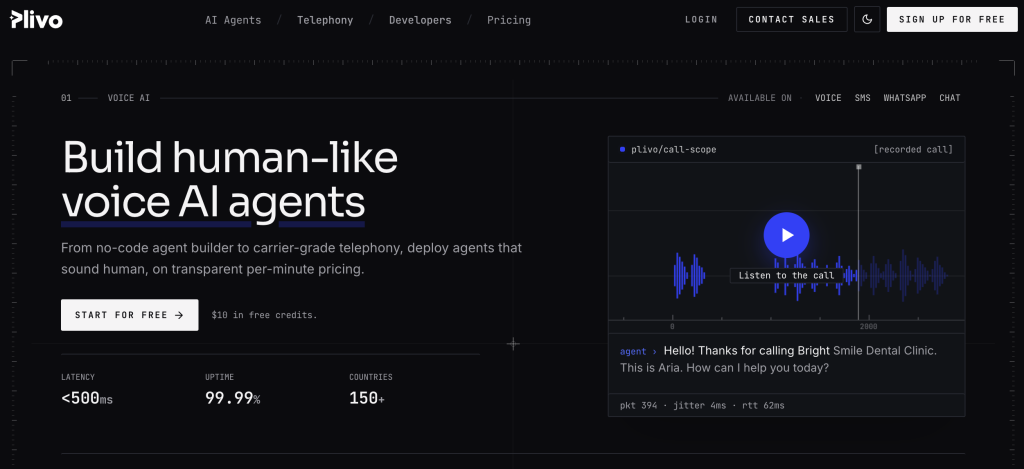
Plivo is a general CPaaS (Communications Platform as a Service, a cloud platform that adds voice, SMS, and video to applications via APIs) for developers building voice, messaging, SIP trunking, and audio streaming pipelines, making it an ameyo alternative for teams that need low per-minute rates and documented AI agent integration paths.
Best for: Voice AI plus SIP trunks at low per-minute cost
Key features
- SIP trunking and audio streaming are documented, so developers can connect voice AI agents built on LiveKit, ElevenLabs, and Vapi to the phone network using Plivo as the carrier layer.
- Published per-minute voice rates start at $0.0010 per minute outbound, which is among the lowest publicly listed rates in this comparison.
- A separate voice AI agent SKU bundles models, transcription, and orchestration at $0.03 per minute, so teams that want a managed AI layer can avoid assembling their own STT, LLM, and TTS stack.
- SMS and number pricing pages are public, making multichannel cost modelling straightforward without a sales call.
- Pipecat-based agent integration is documented, giving teams that already use Pipecat a familiar integration path.
Pros and cons
| Pros | Cons |
|---|---|
| Very low published per-minute rates and transparent pricing pages make cost modelling easy without a sales call | Developers on Reddit reported G711_ulaw audio issues, 3-4 second response lag, and call failures on every 4th or 5th call when using OpenAI Realtime |
| Documented integration with LiveKit, ElevenLabs, and Vapi via SIP trunking covers common AI orchestration stacks | GitHub issues show unresolved number setup errors and call-transfer failures in the AI Voice Agents repository |
| Separate voice AI agent SKU at $0.03 per minute gives teams a managed option without assembling their own AI stack | A developer on r/developersIndia reported that Plivo rejected every outbound call attempt when building a voice assistant |
Pricing
Pricing (India): Outbound calling starts at $0.0010 per minute, inbound at $0.0028 per minute. Enterprise plan starts at $1,000 per month. Voice AI agent SKU is $0.03 per minute excluding telephony. India-specific INR pricing and virtual number details were not publicly surfaced in research. See full pricing
7. Twilio – Global CPaaS with broad channel coverage
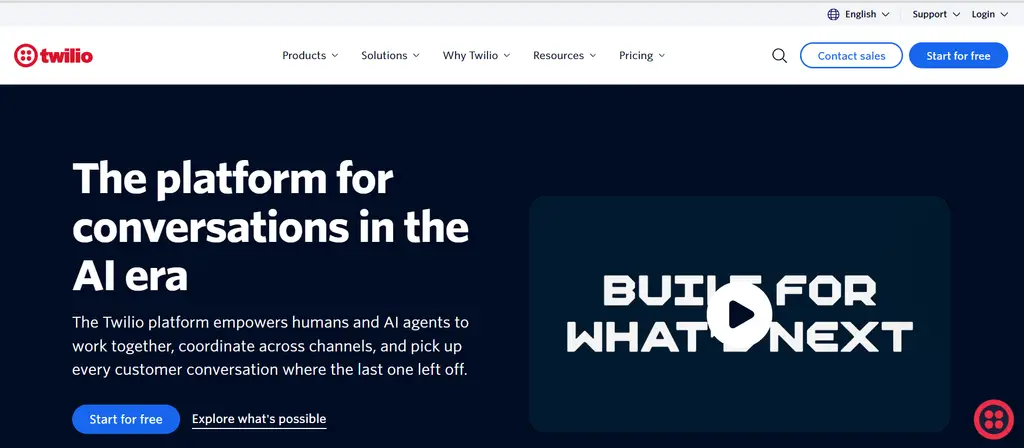
Twilio is a global CPaaS for SMS, voice, video, WhatsApp, verification, and contact-center tooling, making it an ameyo alternative for teams that need a broad multi-channel API surface rather than a purpose-built AI voice infrastructure layer.
Best for: Global CPaaS with multi-channel coverage at scale
Key features
- Broad CPaaS surface across SMS, MMS, VoIP, Verify, Video, WhatsApp, Flex, and Segment gives teams a single vendor for multi-channel communication without managing separate API contracts.
- Pay-as-you-go API billing fits teams that want to start small and scale later without committing to a monthly minimum.
- Flex offers per-user or per-hour contact-center licensing, so teams can run a full agent desk on top of Twilio’s infrastructure.
- Verify has a separate per-check billing model at $0.05 per successful verification, which is useful for OTP and authentication flows in fintech and banking applications.
- WhatsApp and video are first-class products in the same stack, reducing integration complexity for teams that need voice plus messaging in one platform.
Pros and cons
| Pros | Cons |
|---|---|
| Widest multi-channel coverage in this comparison: SMS, MMS, VoIP, WhatsApp, Video, and Verify in one platform | Audio abstraction layer adds latency that makes real-time AI inference difficult compared to raw WebSocket streaming |
| Pay-as-you-go billing with no monthly minimum suits early-stage teams testing call volume before committing | India-specific virtual number, INR pricing, and TRAI compliance details were not publicly surfaced in research |
Ameyo alternative feature comparison: India 2026
| Feature | FreJun Teler | Exotel | Ozonetel | Knowlarity | Airtel IQ | Plivo | Twilio |
|---|---|---|---|---|---|---|---|
| Raw WebSocket audio streaming for AI agents | Yes | Yes, via AgentStream (beta) | No | No | No | Yes, via audio streaming API | Partial, abstracted layer |
| Model-agnostic STT/LLM/TTS integration | Yes | Partial, Google Cloud stack in quick-starter | No | No | No | Partial, managed AI SKU available | Partial, requires custom engineering |
| Transparent INR pricing without sales call | Yes | Partial, INR rate bands published | No | No | No | No, USD only | No |
| TRAI and DoT compliance documented | Yes | Yes | Partial | Partial | Yes | No | No |
| Free credits or trial available | Yes, 3,000 minutes on first upgrade | Yes, limited trial credits | No | No | No | Check website | Yes, trial credits |
| SIP trunking with credential-based auth | Yes | Partial | No | No | No | Yes | Yes |
Teler leads on the combination of raw WebSocket streaming, model-agnostic architecture, transparent INR pricing, and TRAI compliance, which is the exact set of requirements most Indian AI voice agent teams face in 2026.
Which ameyo alternative is right for your team in India?
The right platform depends on your team’s technical depth, call volume, and whether you are building a new AI voice product or extending an existing contact-center stack. Use the decision guide below to match your situation to the right tool.
If you are building a real-time AI voice agent from scratch in India: Choose FreJun Teler. Raw WebSocket streaming, model-agnostic architecture, and transparent INR pricing let you ship a working first call the same day without a sales conversation.
If you need strong India PSTN coverage and a Pipecat-compatible quick-starter: Choose Exotel. The official GitHub voicebot quick-starter and 22-circle PSTN coverage make it a practical choice for teams that want a documented starting point for Google Cloud-based AI stacks.
If you are running a large enterprise contact center with hundreds of agents: Choose Ozonetel. Its per-user pricing and advanced routing tooling suit seat-based procurement models better than per-minute CPaaS billing.
If you need low per-minute rates and already use Vapi or LiveKit as your AI orchestration layer: Choose Plivo. Documented SIP trunking integration with Vapi and LiveKit means you can connect your existing AI stack to Plivo’s carrier network without rebuilding your call control logic.
If you need nationwide Indian virtual numbers backed by a major carrier with DoT compliance: Choose Airtel IQ. Bharti Airtel’s network infrastructure and DoT/TRAI compliance posture suit regulated enterprises that cannot accept carrier risk from smaller providers.
Which ameyo alternative wins overall in India?
If you want the best overall ameyo alternative for developers in India in 2026: Choose FreJun Teler. It is the only platform in this comparison that combines raw WebSocket audio streaming targeting sub-100ms latency, full model-agnostic architecture, transparent INR pricing, and TRAI-compliant carrier connectivity in a single developer-first API.
Frequently asked questions
What is the best ameyo alternative in India in 2026?
The best ameyo alternative in India in 2026 is FreJun Teler. Teler streams raw L16/8000Hz audio over WebSocket with a sub-100ms latency target, so AI inference happens in real time without a proprietary conversion layer adding delay. It is fully model-agnostic, meaning developers bring their own STT, LLM, and TTS providers and pay them directly. Outbound calling starts at ₹0.15 per minute with transparent INR pricing published without a sales call, and TRAI and DoT compliance is handled at the carrier level.
How much does a voice API cost for AI agents in India?
Teler’s India pricing starts at ₹600 per channel per month with a minimum of 10 channels, so the fixed monthly floor is ₹6,000. Outbound calling costs ₹0.15 per minute, inbound costs ₹0.10 per minute, media streaming for AI inference costs ₹0.15 per minute, and recording storage costs ₹0.04 per minute. A team running 10,000 outbound minutes per month with media streaming on every call would pay roughly ₹9,000 in usage fees on top of the channel cost. The first upgrade includes 3,000 free minutes, so initial testing costs nothing beyond the channel fee. Check the current Teler pricing page for the latest figures.
Why does latency matter so much for AI voice agents?
Latency is the delay between when a person speaks and when they hear a response. Human conversation tolerates roughly 200-300ms of delay before it starts to feel unnatural. General CPaaS platforms like Twilio and Plivo abstract the audio layer for human-to-human calls, which adds processing overhead that pushes the round-trip time well above that threshold. Teler removes that abstraction by streaming raw audio directly to the developer’s server over WebSocket, a persistent full-duplex connection, so the STT engine receives unprocessed audio immediately. The full Media Streaming Loop, voice to STT to LLM to TTS to voice playback, targets sub-100ms on Teler, which is fast enough for natural, uninterrupted conversation.
What does model-agnostic mean and why does it matter in production?
Model-agnostic means the voice platform handles only the audio transport layer and does not force you to use a specific STT, LLM, or TTS provider. In production, this matters because AI models improve rapidly. If your telephony provider locks you into a specific STT engine, you cannot switch to a faster or cheaper model without rebuilding your integration. Teler is model-agnostic: it streams raw audio to your server, and your code decides which STT engine transcribes it, which LLM generates the response, and which TTS engine speaks it back. Compatible providers include Google STT, Deepgram, Whisper, OpenAI GPT, Anthropic Claude, ElevenLabs, and Azure TTS, among others. You pay those providers directly, so there is no markup on AI inference costs.
What TRAI rules apply to AI outbound calling in India?
TRAI (Telecom Regulatory Authority of India) and DoT (Department of Telecommunications) set several rules that directly affect AI outbound calling. Promotional calls must use 140-series numbers, while transactional calls use 1600-series numbers. No outbound calls are permitted after 9 PM IST. The NCPR (National Customer Preference Register) blocks calls to registered numbers, so your pipeline must check NCPR before dialling each number. DLT (Distributed Ledger Technology) registration is mandatory for commercial messaging. Teler operates as a DoT-registered carrier, so the underlying infrastructure is compliant. But your application code must still enforce the time window, number series selection, and NCPR check, since those are call-flow decisions that sit above the carrier layer.
What is the difference between SIP trunking and WebSocket streaming for AI voice?
SIP trunking connects your SIP-enabled platform or AI orchestration layer to the carrier network using the Session Initiation Protocol. It is the right path when you already have a SIP-capable system, such as Vapi, Retell AI, or a legacy PBX, and want to add carrier connectivity without rebuilding your call control logic. WebSocket streaming opens a persistent, full-duplex audio channel between the carrier and your server, so raw audio flows in real time with no polling delay. WebSocket is the lower-latency path and the better choice for new AI voice agent builds where you control the full stack. Teler supports both paths: WebSocket for lowest-latency AI voice loops and SIP trunking with TCP/TLS transport for connecting existing SIP infrastructure. You can read more about integration options in the Teler documentation.
How do I get started with a voice API for AI agents in India?
Start by signing up for a Teler account at platform.frejun.ai and upgrading to the first paid plan, which unlocks 3,000 free minutes for testing. The getting-started guide walks you through the WebSocket connection, which uses the same protocol you already know from real-time web applications. Connect your STT engine to the incoming audio stream, pass the transcript to your LLM, convert the response with your TTS engine, and stream the audio back through Teler. The full Media Streaming Loop, voice capture to AI response to voice playback, can be running on a real Indian phone number the same day. For teams that prefer SIP, Teler also supports credential-based SIP trunking that connects directly to Vapi, Retell AI, or any SIP-capable platform. Because Teler is model-agnostic, you are not locked into any AI provider and can swap components as better models become available.
Conclusion: Best ameyo alternative in India for 2026
For developers building AI voice agents in India in 2026, the top three ameyo alternative platforms are FreJun Teler for raw WebSocket streaming and model-agnostic AI infrastructure, Exotel for India-first PSTN coverage with a documented Pipecat quick-starter, and Plivo for low per-minute rates with documented SIP trunking to Vapi and LiveKit. Teler is the top recommendation for any team building a real-time AI voice agent because it is the only platform in this comparison that combines sub-100ms WebSocket latency, transparent INR pricing, TRAI-compliant carrier connectivity, and full model-agnostic architecture in a single developer-first API. The decision now is whether your use case needs the lowest possible latency for conversational AI, which points to Teler, or whether you need a managed contact-center stack with seat-based pricing, which points to Ozonetel or Knowlarity.