AI voice agents are no longer a future-state experiment. Businesses running high-volume call operations, from fintech OTP flows to healthcare appointment reminders, are actively replacing static IVR menus with systems that listen, reason, and respond in real time. The shift is happening because the underlying infrastructure, specifically low-latency media streaming, large language models (LLMs), and programmable telephony APIs, has matured enough to support production deployments at scale. This article covers what’s driving that shift, how the technology actually works, and what your team needs to evaluate before committing to a voice infrastructure partner.
AI voice agents replace rule-based phone menus with real-time, context-aware conversations that connect directly to your business logic and data.
What Is an AI Voice Agent?
An AI voice agent is a software system that handles real-time phone or VoIP (Voice over Internet Protocol) conversations using a pipeline of speech-to-text (STT), a large language model, and text-to-speech (TTS), all connected through a programmable telephony layer that streams audio bidirectionally with sub-500ms latency.
What’s Driving the Sudden Shift Toward AI Voice Agents?
Over the past few years, businesses have undergone significant digital transformation. Customer engagement is no longer limited to chat or email, and voice has re-emerged as the fastest and most natural interaction channel. Yet managing thousands of inbound and outbound calls using traditional contact center models is both expensive and rigid.
That’s where the AI voice agent comes in. An AI voicebot doesn’t just follow a script. It listens, understands intent, retrieves context, and responds instantly, much like a human agent. Unlike legacy IVR systems that rely on button presses, modern voice AI systems hold real-time, two-way conversations over phone networks or VoIP.
“Every engineering team we work with hits the same wall: they build a great AI agent, then spend months wrestling with telephony infrastructure. Teler exists to remove that wall entirely, so teams can ship voice AI in days rather than quarters.”
— Subhash Kalluri, CEO, FreJun
According to Forbes (2026), more than 40% of growing enterprises are now piloting or scaling AI-powered voice interfaces across their support, sales, and internal automation workflows. The push isn’t just about efficiency. It’s about speed, personalization, and scale that traditional contact center models simply can’t match.
With the rise of automation tools and contact center AI, voice has evolved from reactive to proactive. Businesses no longer want to just answer calls. They want to orchestrate intelligent conversations automatically, whether that’s a logistics platform sending proactive delivery alerts or a fintech company running voice-based OTP verification at scale.
The Cost Pressure Behind the Shift
Traditional contact centers scale linearly: more calls require more human agents. This model is costly and hard to maintain across time zones. AI-enabled voice bots can reduce customer service costs by as much as 30% (Source: Druid AI, 2026). Once deployed, an AI voicebot handles hundreds of concurrent calls without burnout, salary overheads, or training cycles, while maintaining consistent service quality and 24/7 availability essential for global operations.
How Do AI Voice Agents Actually Work Under the Hood?
At their core, AI voice agents combine several technologies that work together in real time. The table below shows how these components fit together in a live call pipeline.
| Component | Purpose | Example Functionality |
|---|---|---|
| Speech-to-Text (STT) | Converts user speech into text | Detects intent and transcribes speech accurately in milliseconds |
| Language Model / Agent Logic | Interprets text and decides how to respond | Understands context, queries knowledge, and triggers actions |
| RAG (Retrieval-Augmented Generation) | Adds real-world knowledge to the AI response | Pulls facts, FAQs, or user data from your systems |
| Text-to-Speech (TTS) | Converts AI text response into lifelike audio | Delivers smooth, natural-sounding replies |
| Transport Layer (Telephony/VoIP) | Handles real-time streaming of voice data | Ensures low-latency audio flow in both directions |
Every successful voice AI system depends on how well these layers interact. The key challenge is latency: users expect a human-like rhythm with less than 500 milliseconds of delay between speaking and hearing a response. Streaming architectures solve this by running STT, the agent model, and TTS concurrently rather than sequentially, so data flows continuously and produces near-instant back-and-forth conversation.
The Five-Step Call Loop
- The user speaks into a call.
- The STT engine transcribes audio on the fly.
- The AI agent interprets the text, references company data via RAG (Retrieval-Augmented Generation), and forms a response.
- That response converts back to speech via TTS.
- The transport layer streams it to the user instantly.
The result is a voice experience that feels alive, not mechanical. For a deeper look at how real-time media streaming powers this loop, see what real-time media streaming means for voice AI.
Why Are Businesses Replacing Traditional IVRs With AI Voicebots?
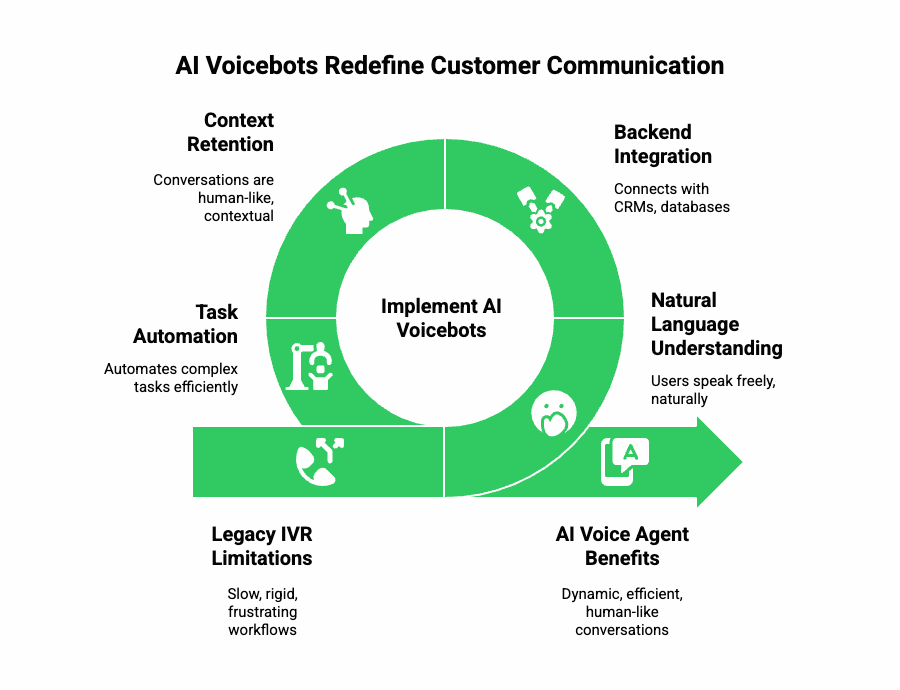
For decades, IVR systems were the backbone of customer communication. They worked, but only to a point. Users pressed 1 for billing, 2 for support, and 3 to speak with an agent. These workflows were slow, rigid, and frustrating for callers who had anything other than a standard request.
Limitations of Legacy IVRs
- Rely on predefined scripts that cannot handle unexpected user intent.
- Require constant manual updates when business processes change.
- Offer poor contextual understanding, treating every call as new.
- Result in long call times and high abandonment rates.
How AI Voice Agents Outperform Them
- Understand natural language, allowing users to speak freely.
- Integrate with backend CRMs, databases, and automation tools.
- Retain context within a session, making conversations more human-like.
- Automate complex tasks like rescheduling, payment, or feedback collection.
A healthcare provider, for instance, can use an AI voicebot to confirm appointments, remind patients, and follow up post-consultation, all without a live representative. An insurance company can handle quote requests or claims initiation automatically, reducing average handling time by over 60% (Source: McKinsey, 2026). AI voice agents don’t just replace IVRs. They redefine how businesses talk to their customers.
Discover how AI is changing inbound call handling with real-time automation and intelligent voice routing.
What Core Business Benefits Are Fueling Adoption?
The business case for AI voice agents rests on three pillars: cost reduction, customer experience improvement, and digital transformation acceleration. Each one compounds the others when you get the infrastructure right.
Cost Reduction and Scalable Operations
Voice AI changes the economics of customer communication. Once deployed, an AI voicebot handles hundreds of concurrent calls without burnout, salary overheads, or training cycles. Businesses achieve lower cost-per-interaction while maintaining consistent service quality. Automation also reduces operational errors and ensures 24/7 availability, which is essential for global businesses that can’t afford downtime.
Enhanced Customer Experience
Customer experience is now the competitive edge. AI voice agents personalize every interaction using stored context and CRM data. Key improvements include instant response times so customers don’t wait on hold, natural communication with real-time understanding and human-like tone, contextual memory that recognizes repeat callers or unresolved queries, and multilingual support with instant translation and local language voice synthesis.
Unlike traditional IVRs that feel transactional, voice AI systems feel conversational. They respond with appropriate tone and adapt in milliseconds, which builds the kind of trust that directly influences brand loyalty and retention.
Catalyst for Digital Transformation
For most enterprises, voice automation isn’t just a support upgrade. It’s part of a larger digital transformation roadmap. AI-driven automation tools now handle repetitive workflows across chat, email, and voice. Integrating these systems into CRMs, ERPs, and support dashboards helps unify customer data and communication flows. Voice AI becomes the final automation layer, connecting natural speech to structured data and bridging the gap between how humans talk and how machines process information.
As more companies adopt cloud infrastructure and modular APIs, implementing voice automation becomes both feasible and essential. Businesses that ignore this shift risk falling behind competitors who operate faster, cheaper, and smarter. For a broader view of how this fits into enterprise architecture, see our guide to voice agent architecture for enterprise apps.
What Makes Today’s Voice Agents Technically Superior?
While early voice assistants were basic, modern systems use deep technical advances in streaming architectures, LLMs, and real-time speech synthesis. Four specific capabilities define the current generation.
1. Low-Latency Media Streaming
Real-time interaction depends on milliseconds. Unlike batch transcription, streaming audio allows partial transcription, incremental processing, and concurrent TTS playback. Modern APIs push latency under 400 to 500ms, eliminating awkward pauses. This is critical for creating fluid, human-like dialogues, especially for contact center AI and customer-facing scenarios. According to FreJun Teler’s 2026 analysis of production call data, deployments using WebSocket-based streaming consistently achieve round-trip latency below 350ms across India, UAE, and Singapore regions.
2. Contextual Understanding via RAG
Static AI models are limited by their training data. RAG overcomes this by fetching real-time data from business systems. When a caller asks about their delivery status, the AI voicebot retrieves details from the logistics database and replies with up-to-date tracking information. This ensures accurate, contextual responses, a major leap from the pre-trained-only approach. For teams building knowledge-aware voice bots, see how to use RAG with voice agents for accuracy.
3. Adaptive TTS and Emotional Range
Voice synthesis has moved well beyond robotic tones. New TTS systems mimic human nuances such as emphasis, emotion, and pauses. This adaptability improves trust and engagement. Adaptive TTS also supports regional accents and local languages, which is a key requirement for global deployment across markets like India, UAE, and Southeast Asia.
4. Multi-Model Compatibility
Today’s systems are modular. You can integrate any STT, LLM, or TTS based on accuracy, cost, and latency needs. This flexibility lets engineering teams design optimal voice stacks without vendor lock-in. Use high-accuracy STT for medical transcription, pair it with a lightweight LLM for task routing, and use expressive TTS for outbound sales calls. This modular approach helps teams balance performance, cost, and scalability across different use cases.
Explore modern inbound call handling strategies and see how AI voice agents speed up customer support operations.
How Can Businesses Actually Build and Deploy an AI Voicebot?
Building a proof-of-concept voice AI is straightforward. Deploying one that scales reliably is a different challenge. Here’s a six-step overview of the deployment process at a conceptual level.
- Capture Voice Input: Route inbound or outbound calls through a secure media gateway or telephony API.
- Process in Real Time: Stream the audio to an STT engine to generate live transcripts.
- Interpret Using LLM: Pass the transcript to your agent logic, which understands context and makes decisions.
- Retrieve Context: Use RAG to fetch relevant knowledge such as FAQs, CRM data, or product information.
- Generate Response: Convert AI output into speech using a TTS engine that streams back audio in real time.
- Deliver Back Through Telephony: The streaming audio plays instantly to the user, completing the conversational loop.
Each step involves low-latency data flow, secure connections, and session-level context. Engineers must handle events like jitter, speech overlap, and API synchronization to ensure a smooth experience. We recommend using streaming endpoints rather than batch APIs, maintaining stateful sessions with context memory, logging all events for observability and debugging, and building fallback logic to handle network errors gracefully.
What Does a Scalable Voice AI Architecture Look Like?
Once the concept is validated, the real engineering challenge is scalability. For large-scale deployments handling thousands of concurrent calls, system architecture defines success. A scalable AI voicebot infrastructure generally includes these layers.
| Layer | Purpose | Key Technologies |
|---|---|---|
| Telephony / VoIP Layer | Handles PSTN or SIP connectivity | Cloud telephony APIs, WebRTC, SIP trunks |
| Media Streaming Layer | Streams live audio in both directions | RTP, WebSocket streaming, gRPC |
| Processing and AI Layer | Runs STT, LLM, RAG, and TTS | Whisper, GPT, Claude, Gemini, ElevenLabs |
| Application Logic Layer | Manages conversation flow and context | Orchestration APIs, state machines |
| Integration Layer | Connects with business systems | REST APIs, GraphQL, internal microservices |
Every millisecond matters here. Traditional HTTP request-response cycles create bottlenecks, so real-time streaming protocols such as WebSockets or RTP are essential for smooth dialogue. To maintain quality at scale, run AI inference asynchronously while streaming tokens as they generate, buffer TTS output dynamically to avoid playback gaps, implement silence detection to optimize speech turn-taking, and distribute workloads geographically for latency reduction.
These principles form the backbone of reliable contact center AI infrastructure, capable of serving hundreds of users concurrently with human-level fluidity. According to Gartner (2026), conversational AI will reduce contact center agent labor costs by $80 billion globally by 2026.
Where Does FreJun Teler Fit Into This Ecosystem?
For most engineering teams, managing telephony, media streaming, and real-time audio pipelines becomes the toughest part of deploying voice automation. Even if you have the best LLM or AI agent, your product is only as good as its voice infrastructure. FreJun Teler acts as the global voice infrastructure layer, the missing piece that connects your AI agent to the real world of phone and VoIP calls.
1. Real-Time Media Streaming Built for AI
Teler’s architecture captures, processes, and streams voice data with ultra-low latency, often below 300 to 400ms round-trip. This ensures users never experience awkward pauses. It supports both inbound and outbound call streaming, making it ideal for AI-powered customer support, sales automation, or appointment bots. You can explore the technical details in the Teler media streaming overview.
2. Model-Agnostic Integration
FreJun Teler is fully model-agnostic. You can connect any LLM, TTS, or STT provider: GPT or Claude for reasoning, Whisper or Deepgram for transcription, ElevenLabs or Play.ht for voice synthesis. Teler doesn’t interfere with your AI logic. It simply ensures reliable voice transport between the user and your system, so you can swap AI components without rebuilding the telephony base each time.
3. Developer-First APIs and WebSocket Endpoints
Engineers can build voice applications quickly using Teler’s APIs. These provide secure WebSocket endpoints for bidirectional streaming, event-based call control including pause, resume, transfer, and record, and session state APIs to retain conversational context. This saves months of infrastructure setup, allowing teams to focus on the AI layer and business logic rather than call routing or audio encoding. See the Teler webhooks overview for how event-driven call control works in practice.
4. Enterprise Reliability and Compliance
FreJun Teler operates on a geographically distributed network, ensuring high availability and resilience against call drops or packet loss. It’s built with enterprise-grade security including TLS encryption, data isolation, and compliance-ready protocols for regulated industries. For teams in fintech or healthtech, this matters as much as latency. Teler provides the plumbing so your AI voicebot can perform without worrying about telephony complexity.
How Do You Integrate Teler with Your AI Stack?
Implementation is straightforward. Think of Teler as the bridge that connects your LLM-driven AI agent with the outside world through phone or VoIP. A simple workflow looks like this.
- Initiate a Call: Your app triggers a voice call via Teler’s REST or WebSocket API.
- Stream Real-Time Audio: Teler sends the live user audio stream to your server or AI endpoint.
- Process via AI Agent: Your system transcribes speech via STT, interprets via LLM, and generates a response.
- Stream Back the Response: The AI’s response via TTS streams back to Teler, which plays it instantly to the caller.
- Maintain Context: Throughout the call, your backend keeps session-level memory, enabling the AI to remember prior exchanges or user preferences.
This modular approach supports plug-and-play flexibility. You can experiment with different AI providers without rebuilding the telephony base each time. That’s why Teler fits into the modern voice AI stack, sitting between cloud telephony and AI processing and ensuring low latency, reliability, and scalability across regions. For teams building on top of agent frameworks, see how Teler and OpenAI’s AgentKit power the next generation of voice AI agents.
What Are the Most Common Use Cases for Voice AI Today?
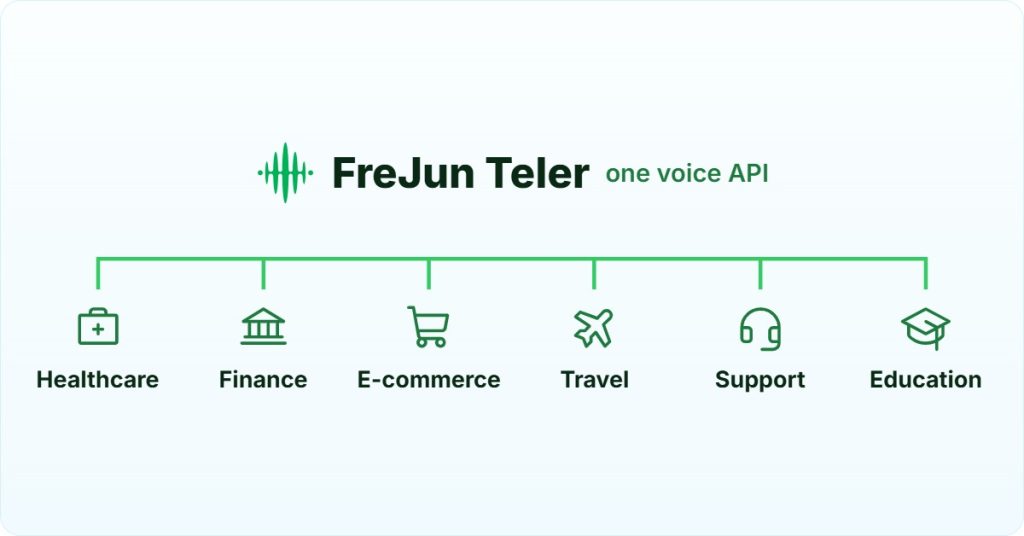
AI voice agents are now deployed across verticals, from startups to large enterprises. The adoption is accelerating most quickly in industries where call volume is high and the cost of human agents is significant.
| Industry | Primary Use Case | Impact |
|---|---|---|
| Customer Support | Automated receptionists, 24/7 helplines | Reduced wait times, faster resolution |
| Healthcare | Appointment scheduling, patient reminders | Lower no-shows, higher engagement |
| Finance and Insurance | Claims intake, lead qualification | Improved compliance and call tracking |
| E-commerce | Order updates, delivery confirmations | Proactive communication and feedback |
| Recruitment and HR | Interview scheduling, screening | Faster candidate workflows |
Across these scenarios, the benefits are consistent: speed, accuracy, and personalization. By using Teler’s infrastructure, businesses can launch multi-region deployments with minimal engineering effort, maintaining audio quality and compliance at scale. For a broader view of where voice AI is being applied, see the top 7 use cases for AI voice agents in business. For customer support specifically, our dedicated guide on the AI customer service agent for phone support covers how these agents handle inbound calls and escalation in practice.
What Should You Evaluate Before Choosing a Voice Infrastructure Partner?
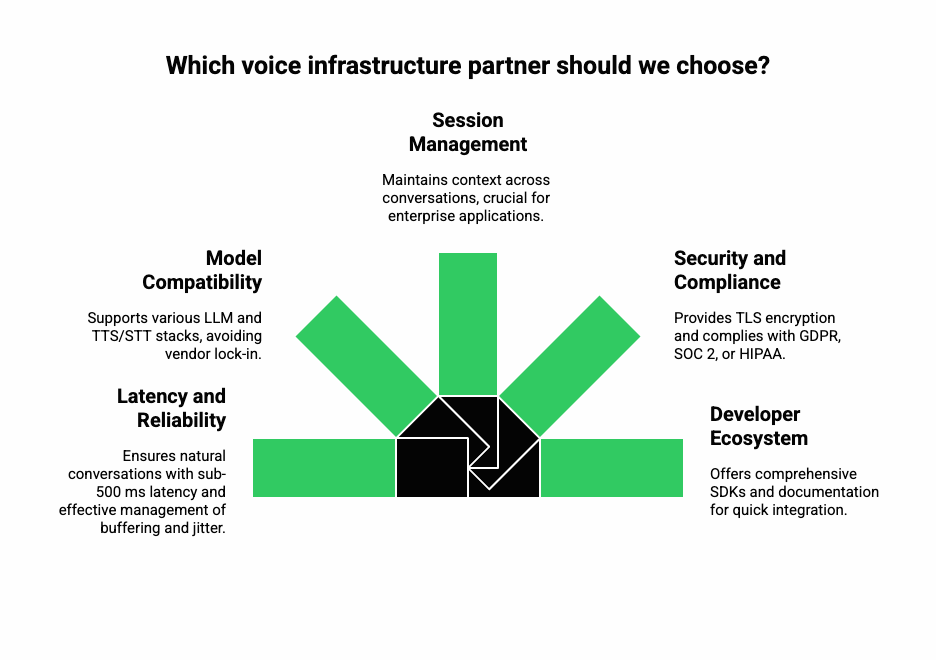
When selecting a voice infrastructure platform, product and engineering leaders should evaluate five key technical parameters. Getting these wrong at the infrastructure layer is expensive to fix later.
1. Latency and Reliability
Sub-500ms latency is non-negotiable for natural conversations. Test how the provider manages buffering, jitter, and geographic routing. A provider that performs well in one region but degrades in another will create inconsistent experiences for global users.
2. Model Compatibility
Ensure the infrastructure supports any LLM and TTS/STT stack, avoiding vendor lock-in and enabling experimentation. If your provider forces you to use their AI models, you lose the ability to optimize your stack as better models emerge.
3. Session Management
Persistent sessions help maintain context across conversations, which is crucial for enterprise-grade contact center AI applications. Without this, every call starts from scratch and the AI can’t reference prior interactions or unresolved issues.
4. Security and Compliance
Look for TLS encryption, data retention controls, and compliance with GDPR, SOC 2, or HIPAA where applicable. For fintech and healthtech teams, the Technical Gatekeeper on your buying committee will block a vendor that can’t demonstrate these controls clearly.
5. Developer Ecosystem
Detailed documentation, sandbox environments, and responsive support accelerate proof-of-concept builds and reduce integration time. FreJun Teler scores well across these parameters. Its architecture is built for speed, reliability, and interoperability, aligning with modern automation tools and enterprise digital strategies. That said, if your primary need is a no-code voice bot builder rather than programmable infrastructure, a platform like Synthflow or Retell AI may be a better starting point before you need the control that Teler provides.
What Does the Future of AI Voice Agents Look Like?
The next evolution of voice AI will go beyond reactive communication. We’re moving toward autonomous, context-aware agents that can act, reason, and learn across channels. Several emerging trends are shaping this direction.
- Multi-turn context retention: AI agents will remember historical interactions across time, not just within a single session.
- Tool calling and automation: Agents will execute tasks such as booking appointments, updating CRMs, and triggering workflows, not just talk.
- Emotion-aware synthesis: TTS models will adapt tone based on sentiment, improving empathy in high-stakes conversations.
- Cross-channel orchestration: Unified AI agents managing both chat and voice within a single context window.
As infrastructure and AI models continue to converge, businesses will no longer ask whether to automate voice. They’ll ask how fast they can scale it globally. The AI voice agents shift is already underway, and the teams that build on solid programmable voice infrastructure today will have a significant head start.
Why Is Now the Right Time to Adopt Voice AI?
Several factors make this the right time for businesses to make the shift to AI voice agents. The infrastructure is mature, the models are accurate, and the cost of inaction is rising.
- Mature Infrastructure: Reliable APIs like FreJun Teler remove the hardest technical barriers to production deployment.
- Advanced Models: Modern LLMs and TTS/STT tools are accurate, faster, and more expressive than anything available two years ago.
- Lower Costs: Cloud pricing and open models have reduced the cost of AI operations by an order of magnitude.
- Customer Expectation: Voice-first experiences are now the norm, not a novelty, across markets in India, UAE, and North America.
AI voicebots are no longer experimental. They are becoming mission-critical for business communication, customer engagement, and operational efficiency. The businesses shifting to AI voice agents now are building a durable competitive advantage, not just a cost-saving measure.
Frequently Asked Questions
An AI voicebot is a system that handles real-time voice interactions using LLMs, STT, TTS, and contextual automation. It listens to a caller, interprets their intent using a language model, retrieves relevant data via RAG, and responds with synthesized speech, all within a single low-latency pipeline connected to a phone or VoIP network.
Voice AI automates inquiries, reduces wait times, maintains session context, and delivers personalized, human-like conversations around the clock. It handles high-volume routine queries without human agents, while escalating complex or sensitive cases to a live person with full context already captured.
For routine and high-volume tasks, AI voice agents handle the majority of interactions without human involvement. Complex decision-making, nuanced negotiations, and regulated scenarios such as medical advice or legal counsel still require human supervision. The practical model is AI handling volume while humans handle exceptions.
Key technologies include LLMs for reasoning, STT for transcription, TTS for speech synthesis, RAG for real-time knowledge retrieval, and a programmable telephony layer for real-time audio streaming. The transport layer, whether SIP trunking or WebSocket-based media streaming, is often the hardest part to get right at scale.
Not with modular platforms like FreJun Teler, which handles streaming, telephony, and low-latency audio infrastructure. Your team connects to Teler’s WebSocket endpoints, routes audio to your AI stack, and streams responses back. Most teams reach a working prototype within a few days rather than months of infrastructure work.
Yes. Modern TTS and STT engines support multiple languages and regional accents, enabling global customer engagement without regional constraints. Teler’s infrastructure supports deployments across India, UAE, Singapore, North America, and Europe, so your voice AI can serve local markets without rebuilding the underlying stack.
With programmable voice infrastructure like Teler, deployment can happen in days rather than months. The platform handles telephony, media streaming, and number provisioning, so your team focuses on agent logic. Production-ready deployments handling real call traffic are achievable within one to two weeks for teams with existing AI model experience.