
AI Summary: This article explains what an AI sales agent is, how one works on a live phone call, and what US businesses need to know before running one in 2026. The Federal Communications Commission (FCC) confirmed in February 2024 that AI-generated voices count as artificial voices under the Telephone Consumer Protection Act (TCPA), meaning prior consent is required before most outbound sales calls. Readers will find a step-by-step call flow, a cost structure breakdown, a compliance table, and a plain account of what goes wrong. FreJun Teler is the voice infrastructure layer that connects an AI system to real phone calls without requiring teams to build phone network infrastructure themselves.
Scope: This article covers AI sales agents used for outbound lead qualification and appointment setting in the United States. Regulatory claims reflect US federal rules and were checked against primary FCC and FTC sources as of September 2026.
Quick Answer: An AI sales agent is software that makes or receives phone calls, speaks with prospects using an AI-generated voice, qualifies leads, and books meetings without a human on the line. In 2026, US outbound sales calls using AI-generated voices require prior express consent under the TCPA. Cost runs on two separate tracks: phone capacity from a telephony provider and AI model usage from a separate AI provider.
An AI sales agent is software that conducts live sales conversations over the phone using an AI-generated voice, handling outbound lead qualification, appointment setting, and routine follow-up without a human representative on the call.
What is an AI sales agent?
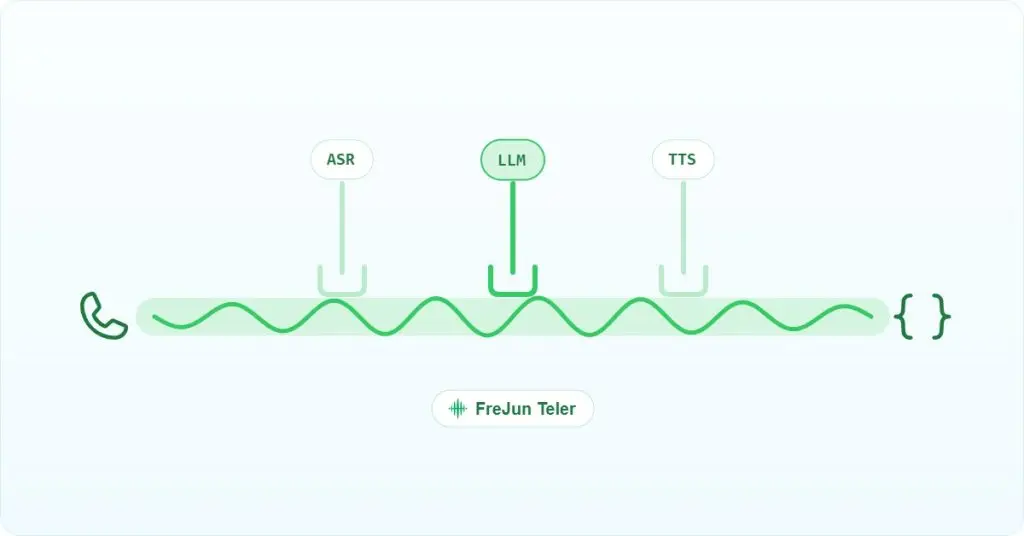
An AI sales agent is a software system that places or receives phone calls, speaks with prospects using a computer-generated voice, asks qualifying questions, and decides whether to book a meeting, transfer to a human, or end the call. A working setup combines a telephony layer that connects to the phone network, a speech recognition system that converts spoken words to text, a language model (LLM, meaning a large AI system trained to understand and generate language) that decides what to say next, a text-to-speech system that turns that response into spoken audio, and integrations to the business’s calendar and customer relationship management (CRM) system. US teams specifically need the system to handle consent verification, do-not-call list checks, and human escalation, because those are not optional features under federal rules.
The most common confusion is between an AI sales agent and a dialer or a chatbot. A dialer only places calls and connects them to a human. A chatbot only sends text messages. An AI sales agent actually speaks on the phone and holds the conversation, which is why it triggers the same federal telemarketing rules that apply to robocalls. It is also not the same as an interactive voice response (IVR) menu, which routes callers through numbered options but does not hold a real conversation.
Why are US sales teams running AI sales agents now?
The practical reason is that the first pass of outbound sales work, dialing, opening the conversation, asking qualifying questions, and booking a time, is repetitive enough that software can do it at a scale no human team can match. The regulatory reason this is happening now rather than five years ago is that the tools have matured enough to be deployed, and the rules have caught up: the FCC confirmed in February 2024 that AI-generated voices fall under the TCPA, which means the compliance framework is settled rather than ambiguous.
The FTC has amended the Telemarketing Sales Rule (TSR, the federal rule governing telemarketing calls) five times since 1995, most recently in December 2024, when it extended coverage to certain inbound calls tied to advertisements or direct-mail offers for technical support. That pattern of active rulemaking is evidence that AI-voice sales calling is a live, regulated practice, not a future concept.
How does an AI sales agent call actually go?
The table below walks one outbound lead qualification call from start to finish. Each row shows what happens, who or what does it, and where things can break.
| Step | What happens | Who or what does it | What can go wrong |
|---|---|---|---|
| 1. Dial | The system loads the lead record and dials the number | Telephony layer and CRM integration | Wrong number, disconnected line, or a number on the do-not-call list that was not scrubbed |
| 2. Connect | The call connects and the AI opens the conversation, identifies the business, and checks whether the person is willing to talk | AI agent with telephony audio | The person hangs up immediately or the opening sounds scripted and robotic |
| 3. Qualify | The AI asks qualifying questions and listens for answers to decide whether the caller fits the target profile | Language model and speech recognition | The system mishears an answer, misclassifies the prospect, or cannot handle an unexpected question |
| 4. Next step | If the caller is interested, the AI offers to book a meeting, send information, or schedule a human follow-up | AI agent with calendar integration | Calendar sync fails, the prospect asks for a time the system cannot offer, or the booking confirmation does not arrive |
| 5. Not a fit | If the caller is not a fit, the AI ends the call politely and logs the outcome | AI agent and CRM integration | The system misjudges fit and ends a call that should have continued |
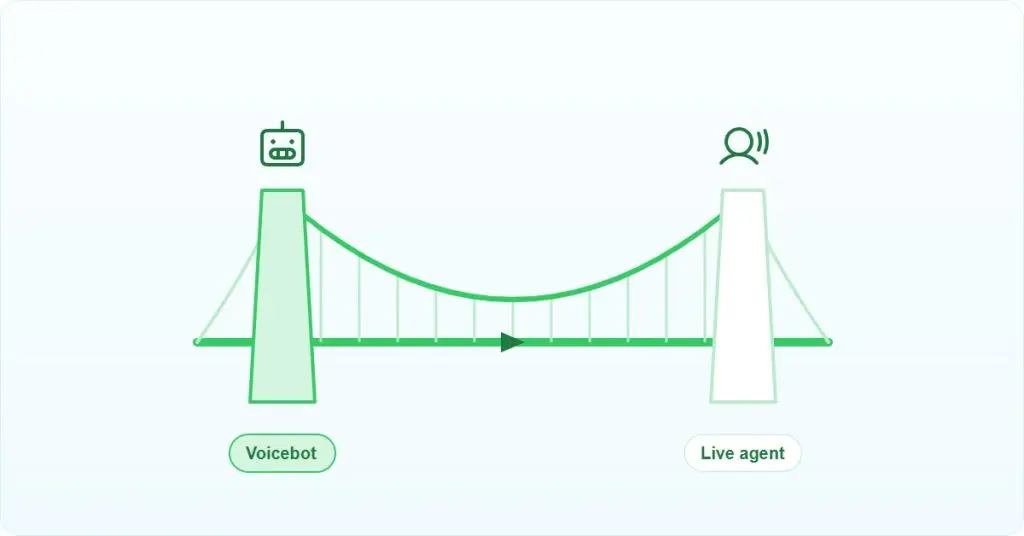
| 6. Escalate | If the caller asks for a person or raises a complex issue, the AI transfers the call or queues a callback | AI agent and telephony transfer | The transfer drops, the human receives no context, or the caller has to repeat everything |
| 7. Log | The outcome, transcript, and any follow-up task are written back to the CRM and calendar | CRM and calendar integrations | The sync fails silently and the record is never updated |
The most important thing to get right is step 6: a caller who asks for a human should reach one quickly, with the conversation summary already in front of that person.
Two things callers notice most. First, the pause before the system responds, which happens while speech is being recognized and the language model decides what to say. Second, what happens when they interrupt mid-sentence. A well-built system handles interruptions the way a person does, stopping and listening rather than finishing its sentence regardless. The underlying infrastructure, a combination of telephony, speech recognition, a language model, text-to-speech, and business-rule logic, runs in the background and is invisible to the caller when it works well.
What does it cost to run an AI sales agent?
Cost runs on two separate tracks that most teams do not model together until the first billing cycle arrives.
| Cost line | Who charges it | What makes it go up |
|---|---|---|
| Phone capacity (simultaneous calls) | Telephony or CPaaS provider | More calls running at the same time |
| Outbound call minutes | Telephony or CPaaS provider | More dials, longer conversations, more retries |
| Phone number rental | Telephony or CPaaS provider | More numbers kept active, more geographies covered |
| Call recording and storage | Telephony or cloud storage provider | Recording volume and how long records are kept |
| Speech recognition (converting speech to text) | AI provider | Total audio processed, number of turns per call |
| Text-to-speech (converting text to spoken audio) | AI provider | Total characters or seconds of audio generated |
| Language model inference | AI provider | Number of calls, length of each conversation |
| Dialog and agent runtime | AI platform vendor or internal build | Workflow complexity and call volume |
| Script and policy maintenance | Internal labor or contractor | Product changes, offer changes, compliance updates |
| Human review of transcripts | Internal labor or outsourced team | Call volume and quality assurance requirements |
| Failed-call handling and callbacks | Internal labor plus telephony usage | Drop rate and how often calls need a second attempt |
| Compliance work and number provisioning | Internal legal or ops, or a specialist vendor | Number of jurisdictions and consent-tracking complexity |
The distinction that surprises most teams is that phone capacity is charged by how many calls run at the same time, while AI model costs are charged by how much is said across all calls. A campaign that runs 200 simultaneous calls for one hour looks very different on the telephony bill than a campaign that runs 20 calls across ten hours, even if the total minutes are identical.
The hidden costs that practitioners report after launch are script rework when the first version does not perform, human review of transcripts for quality assurance, failed-call handling when the system confuses a caller and a human has to follow up, and the time spent on number provisioning and consent-record management before the first call goes out. For current Teler pricing, check current Teler pricing. For other providers such as Twilio, Plivo, and Telnyx, check their respective pricing pages directly, as rates change frequently.
Teams budget for the AI and forget that phone capacity is charged by how many calls run at once, so the first busy campaign day doubles a line they never modelled. The telephony bill and the AI bill are separate invoices from separate vendors, and both go up when volume spikes.
– Subhash Kalluri, Founder & CEO, FreJun
What does it take to set up an AI sales agent?
Setup divides into what the business must supply and what the platform supplies. Neither side can substitute for the other.
The business supplies the phone number or numbers, the call script and qualification criteria, documented consent records for the contacts being called, access to the CRM and calendar systems, and a named person responsible for reviewing transcripts and handling escalations. Without those inputs, no platform can run a compliant campaign.
The platform supplies the telephony connection to the phone network, the speech recognition and text-to-speech processing, the language model runtime, call recording, and the transfer mechanism for handing off to a human. FreJun Teler, for example, handles the phone network, carriers, numbers, and audio so a team’s AI can answer and make calls without building phone infrastructure. It works with whichever speech and language models the team chooses, with no lock-in to a single AI provider. Prototyping is available without a credit card, and the Teler developer documentation covers the integration steps for connecting AI models to live calls.
Systems the AI sales agent must connect to
A working deployment connects to at least four categories of business system. The CRM holds the lead records and receives call outcomes. The calendar system handles booking and availability. A ticketing or case management system receives escalated issues that need human follow-up. Order or billing systems may be needed if the agent is expected to answer account questions. Each integration is a potential failure point, so testing each one before the first live call is not optional.
On the build-versus-buy question: building the telephony and AI layers from scratch makes sense only when the business has specific requirements that no existing platform meets, such as a proprietary speech model or a carrier relationship that must be preserved. For most teams, the setup time, the ongoing maintenance of the phone infrastructure, and the compliance tooling make a platform the faster and lower-risk path. The Teler API documentation shows what a platform integration looks like at the infrastructure level for teams evaluating the build option.
What rules apply to an AI sales agent in the US?
US outbound sales calls using AI-generated voices are governed by two federal frameworks. The table below covers the confirmed rules. This is a descriptive summary, not legal advice.
| What the rule requires | Who it applies to | Who is responsible | Source |
|---|---|---|---|
| Prior express consent before making an AI-generated or prerecorded voice call to a residential line | Any business placing outbound calls using an AI-generated voice | The business placing the call | FCC Declaratory Ruling FCC-24-17, adopted 2024-02-02, released 2024-02-08 |
| Specific disclosures at the start of the call, including the name of the seller and the purpose of the call | Telemarketers and sellers | The business or telemarketer | FTC Telemarketing Sales Rule, 16 CFR Part 310 |
| No calls to consumers who have asked not to be called again; scrubbing against the National Do Not Call Registry | Telemarketers and sellers | The business or telemarketer | FTC Telemarketing Sales Rule, 16 CFR Part 310 |
| Calls only between 8 a.m. and 9 p.m. local time of the person being called | Telemarketers and sellers | The business or telemarketer | 16 CFR Part 310, current text read 2025-01-10 |
| Caller identification must be transmitted accurately and not blocked | Telemarketers and sellers | The business or telemarketer | 16 CFR Part 310, current text read 2025-01-10 |
| Abandoned call limits: no more than three percent of calls answered by a live person may be abandoned | Telemarketers using predictive dialers or automated systems | The business or telemarketer | FTC Complying with the Telemarketing Sales Rule |
| Certain inbound calls in response to an advertisement or direct-mail offer for technical support are now covered by the TSR | Businesses receiving inbound calls tied to such offers | The business or telemarketer | FTC Final Rule amending TSR, published 2024-12-10, effective 2025-01-09 |
The obligation to collect consent, scrub lists, and handle opt-outs sits with the business placing the call, not with the platform. A telephony or AI platform can support compliance by providing recording, logging, and transfer tools, but it does not carry the legal duty unless it is itself the caller or telemarketer. The FCC has established working relationships with 48 state attorneys general and has issued hundreds of millions of dollars in enforcement actions against illegal robocallers, so non-compliance carries real financial risk.
Before the first call goes out, a business should confirm consent is documented for every number on the list, the list has been scrubbed against the National Do Not Call Registry, the script includes the required opening disclosures, the system can handle opt-out requests in real time, and a human escalation path is in place for calls that cannot be handled by the AI.
What goes wrong with an AI sales agent?
The table below covers the most commonly reported failure modes, based on practitioner accounts from 2024 to 2026. These apply to any AI sales agent platform, including Teler.
| Problem | Why it happens | What to do about it |
|---|---|---|
| Zero meetings booked over weeks of running | Wrong target list, a script that does not match the audience, or a qualification threshold set too high | Test the script with a small batch before scaling; review every call transcript from the first week |
| Conversations feel brittle when a prospect pushes back | The system was not trained on realistic objections and cannot handle interruptions gracefully | Build objection handling into the script; test with real interrupters before launch |
| The AI gives confidently wrong answers on product details | The language model was not given accurate, current product information, or was trained on bad data | Keep the knowledge base the AI draws from current and narrow; do not let it improvise on product facts |
| Fully autonomous outbound books meetings with unqualified prospects | The qualification criteria were too loose, or the system was given too much autonomy without human review | Set tighter qualification rules; have a human review bookings before they are confirmed |
| Domain or number reputation damaged by high-volume unreviewed outreach | Too many calls sent too fast without checking deliverability or answer rates | Ramp volume gradually; monitor answer rates and drop rates daily in the first two weeks |
| Human receives no context after a transfer | The escalation path was not built to pass the transcript and caller intent to the receiving agent | Require the system to send a summary to the human before the transfer completes |
The single most common root cause across these failures is deploying at full volume before the script and qualification logic have been tested on real calls.
When should you not use an AI sales agent?
An AI sales agent is the wrong tool in several specific situations, and being clear about them saves time and money.
If call volume is low enough that a human rep can handle it without a backlog, the setup cost and compliance overhead of an AI system will not pay back. A team making 50 outbound calls a week does not need automation.
If the conversation requires judgment that cannot be scripted, such as negotiating a custom contract, handling a complaint from a long-standing client, or discussing a sensitive account issue, a human must be on the call. The AI is good at the repeatable front end of a sales conversation, not at the parts that require relationship judgment.
If the interaction requires a licensed professional, such as a financial advisor, a licensed insurance agent, or a healthcare provider, the AI cannot substitute. The licensed person must be the one speaking.
If the customer base is known to reject automation, for example, a high-value enterprise segment where buyers expect a named account manager, deploying an AI agent will damage the relationship before it starts. Some audiences will simply hang up, and no amount of script refinement changes that.
Finally, if the business cannot yet document prior express consent for the contacts it wants to call, it should not run outbound AI-voice calls at all until that consent is in place.
Frequently asked questions
What is the best way to build an AI sales agent for outbound calls?
Start with a narrow use case, such as qualifying inbound leads or booking discovery calls, rather than full autonomous outbound. Connect a telephony layer like Teler to your chosen language model, write a script that covers your top five objections, and test on a small batch before scaling. Most teams that succeed start with human review of every booking for the first two weeks, then automate once the qualification logic is proven.
How much does an AI sales agent cost to run?
Cost splits across two separate vendors: the telephony provider charges for phone capacity and call minutes, while the AI provider charges for speech recognition, text-to-speech, and language model usage. Both bills go up with volume, but in different ways. Phone capacity is charged by how many calls run at once; AI costs are charged by how much is said. For current figures, check current Teler pricing and compare with Twilio, Plivo, and Telnyx directly.
What law governs AI voice sales calls in the US?
Two federal frameworks apply. The Telephone Consumer Protection Act (TCPA), as interpreted by the FCC’s February 2024 declaratory ruling, requires prior express consent before making AI-generated voice calls to residential lines. The FTC’s Telemarketing Sales Rule (TSR, 16 CFR Part 310) requires disclosures, do-not-call compliance, call-time limits, and accurate caller identification. Both apply to outbound sales calls using an AI-generated voice.
Will callers know it is not a person, and does that matter?
Many callers will recognize an AI voice, especially if the system pauses noticeably or handles interruptions poorly. Whether it matters depends on the audience. For high-volume lead qualification where the prospect expects a quick screening call, most people accept it. For high-value enterprise relationships, it often damages trust. The TSR requires the caller to identify the business and the purpose of the call at the start, so the agent must be transparent about who is calling even if it does not explicitly say it is an AI.
Should we build our own AI sales agent or use a platform?
Building from scratch is right only when the business has specific requirements no platform meets, such as a proprietary speech model or a carrier relationship that must be preserved. For most teams, a platform handles the telephony, speech processing, and call controls faster and with less ongoing maintenance. Teler, for example, connects AI systems to live phone calls and works with any speech or language model the team chooses, without requiring teams to build phone network infrastructure. The build path makes sense when the platform path has a clear gap.
What happens when the AI does not understand someone?
A well-built system asks for clarification once, then transfers to a human if the answer is still unclear. The worst outcome is a loop where the AI keeps asking the same question. Build a fallback into the script: after two failed attempts to understand a response, the system should offer to connect the caller with a person. The human should receive the transcript of what was said before the transfer.
How long does setup actually take?
The technical connection between a telephony platform and an AI model can be done in days. The parts that take longer are writing and testing the script, verifying consent records for the contact list, scrubbing the list against the National Do Not Call Registry, and setting up the CRM and calendar integrations. Most teams spend two to four weeks on those steps before the first live call. Compliance work, especially for teams new to telemarketing rules, can add another week.
How do we measure whether the AI sales agent is working?
The metrics that matter are answer rate (how many dials connect), qualification rate (how many connected calls result in a qualified lead), booking rate (how many qualified leads book a meeting), transfer rate (how many calls escalate to a human), and callback completion rate (how many escalated calls are actually followed up). Drop-off rate, meaning how many callers hang up before the qualification step, tells you whether the opening is working. Review these weekly for the first month. For guidance on tracking these in real time, see how to add real-time analytics with an AI voice agent API.
What will change about AI sales agents over the next two years?
The compliance environment will keep moving. The FTC has amended the TSR five times since 1995, and the FCC’s 2024 AI-voice ruling is already being used by state attorneys general as an enforcement tool. On the capability side, the gap between AI and human conversation quality is narrowing, but the judgment gap on complex objections and relationship-sensitive calls remains real. Teams that build compliance and human escalation into the design now will be better positioned as rules tighten. For a broader view of where voice AI is heading, see what future trends are shaping voice bot solutions in 2026.
Is an AI sales agent right for your business?
The decision comes down to one factor: whether the front end of your sales process is repetitive enough to script and regulated enough to document. An AI sales agent handles the repeatable first pass of outbound qualification well, but it does not replace the judgment a human brings to complex objections, sensitive accounts, or licensed interactions.
If your call volume is high, your qualification criteria are clear, and you can document prior express consent for every number on your list, an AI sales agent is worth evaluating seriously in 2026. If any of those three conditions is missing, start with the missing piece before touching the technology. For teams ready to connect an AI system to live phone calls, FreJun Teler provides the voice infrastructure layer without requiring teams to build phone network infrastructure themselves. For teams evaluating the broader landscape of voice AI platforms, the top AI voice agent platforms in the US is a useful starting point.