
AI Summary: This article explains how an AI answering service works, what it costs to run, and what US law requires, for business owners and operations leads evaluating whether to automate inbound call handling in 2026. The Federal Communications Commission (FCC) confirmed in February 2024 that AI-generated voices fall under the Telephone Consumer Protection Act (TCPA), which governs consent and caller identification rules. Readers will find the full call flow, a breakdown of every cost line, the compliance steps that stay with the business rather than the platform, and a clear account of when automation is the wrong choice. FreJun Teler is the infrastructure layer that connects an AI system to live phone calls without requiring the business to build phone network infrastructure.
Scope: This article covers AI answering services as deployed by US-based businesses, applying US federal rules from the FCC and the Federal Trade Commission (FTC). Regulatory and market claims were checked against primary sources as of September 2026.
Quick Answer: An AI answering service is software that picks up inbound calls, carries on a real conversation with the caller, and transfers to a human when the issue needs judgment. In 2026, costs break into phone capacity, per-minute call charges, and AI model fees. Outbound use triggers FCC and FTC consent rules that the business, not the platform, must satisfy.
An AI answering service is a system that answers phone calls with a synthetic voice, handles routine caller questions through natural conversation, and passes the call to a human when the situation requires judgment or falls outside what the system can resolve.
What is an AI answering service?
An AI answering service is software that answers inbound phone calls with a synthetic voice, holds a real back-and-forth conversation with the caller, completes routine tasks such as booking appointments or answering common questions, and transfers the call to a human when the situation needs judgment. A working setup combines phone lines and routing, speech recognition that converts what the caller says into text, a language model that decides what to say next, voice generation that speaks the reply aloud, and connections to the business systems the AI needs to look things up or take action.
The term is most often confused with an interactive voice response system, usually called an IVR, which only routes callers through a menu of numbered options and cannot hold a conversation. It is also confused with a live virtual receptionist, who is a human answering calls on behalf of the business. The difference matters: an IVR routes, a receptionist is a person, and an AI answering service actually talks with the caller and tries to resolve the reason for the call.
Why are businesses setting up AI answering services now?
Missed calls cost businesses leads and appointments, and staffing a phone line around the clock is expensive. The technology to hold a convincing phone conversation has matured enough that businesses in construction, healthcare scheduling, home services, and retail are running it in production today, not in pilot.
The regulatory environment has also clarified. The FCC confirmed in February 2024 that AI-generated voices fall under the TCPA’s rules on artificial or prerecorded voice calls, which means the legal framework is settled enough for businesses to plan around it. That clarity, combined with falling AI model costs, is what moved this from experiment to standard practice for many small and mid-sized operations.
One operator in a construction industry forum noted that roughly 80 to 90 percent of inbound calls to their business were spam or scams, making an AI filter on the front of the line genuinely useful before a human ever picks up.
What does an AI answering service cost to run?
The call flow is straightforward, but each step has a failure point worth knowing before you build or buy.
| Step | What happens | Who or what does it | What can go wrong |
|---|---|---|---|
| 1. Call arrives | The caller dials the business number | Phone carrier routes the call to the AI system | Routing misconfiguration sends the call nowhere |
| 2. Greeting | The system answers and introduces itself | AI voice generation speaks the opening line | Slow answer time frustrates the caller before the conversation starts |
| 3. Listening | The caller speaks; the system converts speech to text | Speech recognition layer | Background noise or an accent the model was not trained on causes a misread |
| 4. Understanding intent | The system decides what the caller wants | Language model reads the transcribed text | Ambiguous phrasing leads to the wrong response path |
| 5. Answering or acting | The system replies or looks something up in a connected system | Language model plus business system integration | Missing data in the calendar or customer record causes a dead end |
| 6. Completing or transferring | The task is done, or the call goes to a human | Call routing logic | Transfer drops the call or sends the caller to the wrong person with no context |
The table shows that most failures happen at the edges: the moment the call arrives and the moment it leaves the AI.
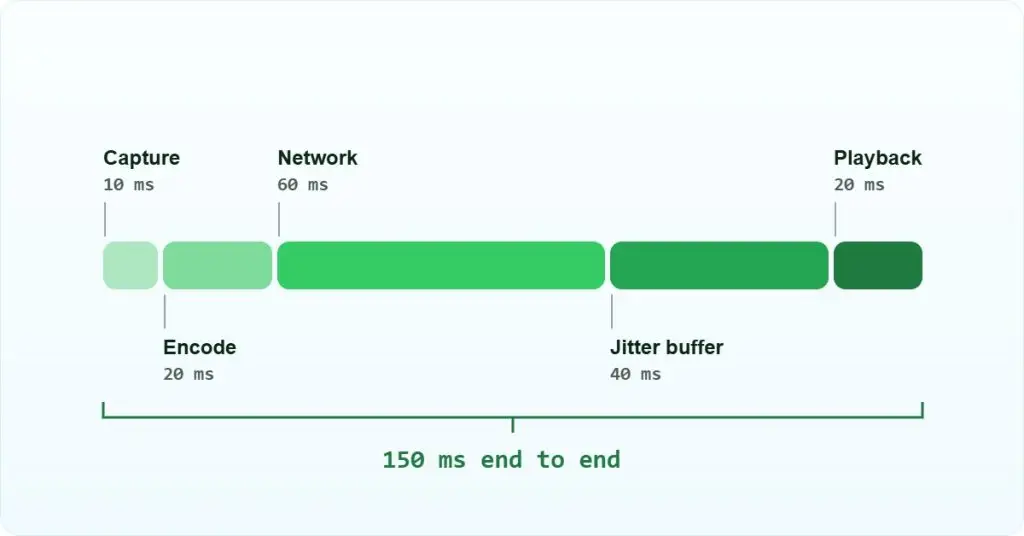
Two things callers notice most are the pause before the system responds and what happens when they try to speak while the AI is still talking. A well-configured system can be interrupted mid-sentence, the way a person can, so the caller does not have to wait for the AI to finish before they can correct it or ask something different. When that interruption handling is poor, the conversation feels robotic and callers hang up.
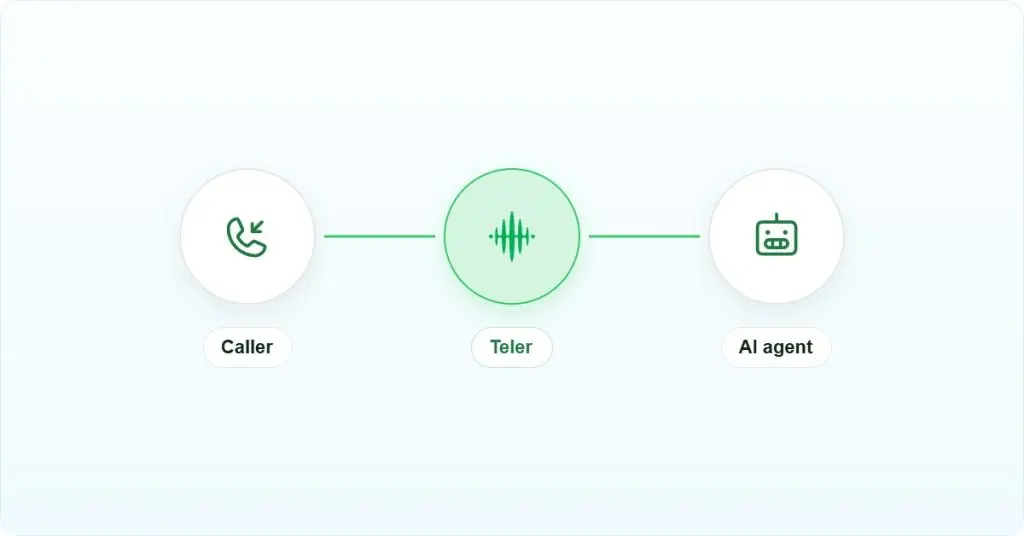
Underneath the conversation, a voice platform carries the audio between the phone network and the AI. It handles the phone lines, the carriers, and the audio routing so the AI can focus on the conversation rather than the infrastructure. The business or its developers still choose which speech recognition and language models to use.
What does an AI answering service cost to run?
Cost for an AI answering service breaks into several distinct lines, and knowing which ones rise with call volume versus which ones rise with simultaneous calls is the distinction that surprises most teams when the first bill arrives.
| Cost line | Who charges it | What makes it go up |
|---|---|---|
| Phone capacity | Telephony provider | More calls happening at the same time |
| Inbound call minutes | Telephony provider | More calls and longer conversations |
| Outbound call minutes | Telephony provider | Callbacks, reminders, and follow-up volume |
| Phone number rental | Telephony provider | More active numbers kept on the account |
| Call recording and storage | Telephony or communications platform | Longer retention periods and higher call volume |
| Speech recognition and voice generation | AI model provider | Audio duration and the amount of processing per call |
| Language model usage | AI model provider | Length of conversations and complexity of responses |
| Workflow and integration layer | Platform or integration provider | Number of connected systems and actions triggered per call |
| Setup and maintenance labor | Internal team or implementation partner | Complexity, frequency of changes, and compliance review |
The key distinction is that phone capacity is charged by how many calls run at the same time, while AI model costs are charged by how much is said during each call. A business with a busy Monday morning will pay more for capacity even if average call length stays the same.
Beyond the line items above, four hidden costs appear after launch. First, prompt and script rework: the initial scripts rarely survive contact with real callers, and rewriting them takes time. Second, human transcript review: someone on the team needs to read transcripts or listen to calls to catch mistakes and improve the system. Third, failed-call handling: when the AI mishears a caller or drops a transfer, a staff member has to recover that lead or appointment. Fourth, compliance registration effort: before any outbound calling, the business has to set up consent records, opt-out handling, and suppression lists, and that work takes time even when no government registration is required.
For current Teler pricing, check current Teler pricing. For other platforms such as Twilio, Plivo, Telnyx, Bandwidth, and Sinch, check each provider’s pricing page directly, since rates change and the structure varies by region and volume.
Teams budget for the AI and forget that phone capacity is charged by how many calls run at once, so the first busy Monday doubles a line they never modelled.
– Subhash Kalluri, Founder & CEO, FreJun
What does it take to set up an AI answering service?
Setup divides cleanly into what the business supplies and what the platform supplies. Mixing them up is where projects stall.
The business supplies the phone number or numbers, the call script and the answers to common questions, access to the calendar or booking system, access to the customer record system (called a CRM, or customer relationship management system), and a named person responsible for reviewing calls and approving changes. The business also decides which calls should never go to the AI and what the human fallback path looks like.
The platform supplies the phone infrastructure, the audio routing, the speech recognition and voice generation connections, and the call controls such as transfer, hold, and recording. FreJun Teler, for example, connects an AI system to live phone calls and handles the carrier layer, so the team building the service does not need to manage phone network infrastructure directly. The platform documentation at frejun.ai/docs covers the integration steps for teams building on top of it.
Systems the AI answering service must connect to
A receptionist-style AI answering service typically needs to read from and write to at least three categories of business system: a calendar or scheduling tool so it can book and confirm appointments, a customer record system so it can identify the caller and pull up their history, and a ticketing or task system so it can log the reason for the call and any action taken. Some businesses also connect an order management system for status lookups or a knowledge base for product and policy questions. The more systems the AI can reach, the more calls it can resolve without a transfer.
On the build-versus-buy question: buying a pre-built AI answering service makes sense when the call flows are standard, the business does not have a developer on staff, and speed to launch matters more than customization. Building on a programmable voice platform makes sense when the business has unusual call logic, needs deep integration with proprietary systems, or wants to control exactly which AI models handle the conversation. For most small businesses running fewer than a few hundred calls a day, a pre-built product is the faster and cheaper path. For teams with a developer and a specific workflow, building on infrastructure like Teler gives more control. The guide to choosing custom voice API integration over off-the-shelf solutions covers this decision in more detail.
What rules apply to an AI answering service in the US?
US law on automated voice calls is specific and the obligations stay with the business placing or receiving the calls, not with the platform. This section describes the rules as of September 2026 and is not legal advice.
| What the rule requires | Who it applies to | Who is responsible | Source |
|---|---|---|---|
| AI-generated voices are treated as artificial or prerecorded voices under the TCPA (Telephone Consumer Protection Act, the federal law governing automated calls) | Any business using AI voice on calls | The business placing the call | FCC Declaratory Ruling FCC-24-17A1, February 2024 |
| Prior written consent required before making a prerecorded or AI-voice telemarketing call to a home or wireless number | Businesses making outbound telemarketing calls | The business / seller | FCC, Stop Unwanted Robocalls and Texts |
| Caller must identify themselves clearly and provide a callback number on every call | Any caller using artificial or prerecorded voice | The business | FCC, Telemarketing |
| Telemarketing calls must include an automated opt-out path so the caller can request not to be called again | Businesses making telemarketing calls | The business | FCC, Stop Unwanted Robocalls and Texts |
| Outbound telemarketing calls delivering a prerecorded message are prohibited unless the recipient gave prior signed written agreement | Sellers and telemarketers | The business / seller | FTC, Complying with the Telemarketing Sales Rule |
| Telemarketing Sales Rule (TSR, 16 CFR Part 310) requires material disclosures, prohibits misrepresentations, sets call-time limits, and bans calls to consumers who asked not to be called | Telemarketers and sellers | The business / telemarketer | FTC, Telemarketing Sales Rule, updated September 2026 |
| Do-not-call obligations: maintain suppression lists and honor opt-out requests | Any business making telemarketing calls | The business | FTC, Telemarketing Sales Rule |
The table makes clear that every obligation in it sits with the business, not the platform. Using a voice platform does not transfer consent duties, opt-out handling, or caller identification requirements to the provider.
For inbound-only use, where the AI answers calls that customers dial in, the consent and telemarketing rules above are less directly relevant because the caller initiated contact. The rules become critical the moment the business uses the system to call customers back, send appointment reminders, or run any outbound campaign. Before the first outbound call, the business needs consent records in place, an opt-out path in the call flow, a suppression list that removes anyone who asked not to be called, and caller identification set correctly. No federal pre-launch registration was found in the FCC or FTC sources reviewed, but the consent and identification requirements must be satisfied before the call goes out, not after.
The most recent AI-specific federal change is the FCC’s February 2024 ruling. Teams building on Teler can find compliance-relevant integration guidance in the platform documentation.
What goes wrong with an AI answering service?
| Problem | Why it happens | What to do about it |
|---|---|---|
| The system sounds mechanical and breaks down on anything beyond simple questions | The script covers too narrow a range of caller phrasing, or the language model is not given enough context about the business | Expand the script using real call transcripts; test with varied phrasing before launch |
| Callers hang up when they realize they cannot reach a person quickly | The transfer path is buried or requires too many steps | Make the option to speak to a person available at any point in the conversation |
| The AI cuts off the caller or pauses awkwardly | Interruption handling is not configured correctly, or the system response time is too slow | Choose a platform that supports mid-sentence interruption and test response time under realistic conditions |
| The AI behaves unexpectedly in a live call, such as the HVAC case where the system was reported to yell at a customer | Edge cases in the prompt or model behavior that were not caught in testing | Run adversarial tests before launch; monitor live calls in the first weeks |
| Message-taking only frustrates callers | The system takes a message but does not resolve anything, so the caller gets no value from the interaction | Connect the AI to the systems it needs to actually answer questions or book appointments |
These problems are not hypothetical: each one above comes from operator accounts reported between 2025 and 2026, and the interruption and message-taking issues appear across multiple independent sources. One honest limitation applies to any AI answering service, including those built on Teler: if the business data the AI needs to answer a question is missing, outdated, or locked in a system the AI cannot reach, the call will fail regardless of how good the voice technology is.
When should you not use an AI answering service?
An AI answering service is the wrong choice in several specific situations, and being clear about them before you buy saves a painful rollback.
Do not use it if all you want is message-taking. Operators who deployed message-taking-only systems reported that callers found it frustrating and a waste of time, because the interaction resolved nothing. If the AI cannot actually answer questions or complete a task, a voicemail box does the same job with less complexity.
Do not use it on front-desk lines where your customers will quit rather than work through a machine. Some customer bases, particularly older callers or those in distress, will hang up the moment they realize they are not speaking to a person. If your abandonment rate rises after launch, that is the signal.
Do not use it for fast-moving dispatch or support lines where the conversation requires rapid back-and-forth and the AI’s response time creates noticeable pauses. HVAC dispatch, emergency services, and similar workflows are high-risk environments for the current generation of AI answering systems.
Do not use it for conversations that legally require a licensed human, such as certain financial advice, medical consultations, or legal guidance. The AI can route and triage, but the substantive conversation must involve a qualified person.
Do not use it for outbound telemarketing until consent records, opt-out handling, and suppression lists are already in place. The FCC and FTC rules described above apply from the first call, and the obligation sits with the business.
Frequently asked questions
What is the best way to set up an AI answering service for a small business?
Start with a pre-built product rather than building from scratch. Connect it to your calendar and customer record system before launch, write scripts using real questions your team already answers by phone, and keep a human fallback path available at every point in the conversation. Test with varied caller phrasing before going live. The guide to starting voice bots for customer support covers the build path for teams with a developer on staff.
How much does an AI answering service cost?
Cost breaks into phone capacity, per-minute call charges, AI model fees, and integration labor. Phone capacity rises with simultaneous calls; AI model fees rise with conversation length. Hidden costs include script rework, transcript review, and failed-call recovery. For current figures, check current Teler pricing and compare against the pricing pages of Twilio, Plivo, Telnyx, Bandwidth, and Sinch directly, since rates vary by volume and region.
What law governs AI voice calls in the US?
The primary federal rules are the TCPA (Telephone Consumer Protection Act, 47 U.S.C. § 227), enforced by the FCC, and the Telemarketing Sales Rule (16 CFR Part 310), enforced by the FTC. The FCC confirmed in February 2024 that AI-generated voices count as artificial or prerecorded voices under the TCPA, so consent and caller identification requirements apply. The FTC’s Telemarketing Sales Rule sets call-time limits, disclosure requirements, and do-not-call obligations for outbound telemarketing.
Will callers know they are not speaking to a person, and does that matter?
Many callers will realize it, especially if the system pauses awkwardly or misunderstands them. Whether it matters depends on your customer base and the nature of the call. For routine tasks like appointment booking or order status, most callers accept it. For sensitive or complex conversations, the expectation of a human is higher and the cost of a bad interaction is greater. The FCC’s caller identification rules require the system to identify itself clearly, which means the business cannot actively deceive callers about whether they are speaking to a person.
Should I build an AI answering service or buy one?
Buy if your call flows are standard and you do not have a developer available. Build on a programmable voice platform if you need deep integration with proprietary systems, unusual call logic, or control over which AI models handle the conversation. FreJun Teler is designed for the build path: it connects AI systems to live phone calls and handles the phone infrastructure, so the team focuses on the conversation logic rather than the carrier layer. Most small businesses without a developer are better served by a pre-built product.
What happens when the AI does not understand a caller?
A well-configured system will ask the caller to repeat or rephrase, and if it still cannot understand, it will offer to transfer to a human. The failure mode to avoid is a loop where the system keeps asking the same question without offering an exit. Every AI answering service should have a maximum number of failed attempts before it routes to a person, and that threshold should be set conservatively at the start.
How long does setup actually take?
A pre-built product with a standard call flow can be live in days if the business already has its scripts and system access ready. A custom build on a programmable voice platform takes longer, typically weeks, because the integration work, prompt writing, and testing each take time. The part that most teams underestimate is the script and prompt iteration after the first real calls come in. Plan for at least two to four weeks of refinement after the initial launch before the system handles calls reliably.
How is AI answering service technology likely to change in the next two years?
Response times are getting shorter as AI model inference speeds up, which reduces the pauses callers notice. Interruption handling is improving, making conversations feel less scripted. The regulatory environment is also moving: the FCC has proposed a formal definition of AI-generated calls and is considering additional disclosure requirements beyond what the 2024 ruling established. Businesses building on this technology now should expect the compliance requirements to tighten, not loosen, and should build consent and opt-out handling into the system from the start rather than adding it later. The overview of future trends shaping voice bot solutions covers the technology direction in more detail.
Is an AI answering service right for your business?
An AI answering service earns its place when the business has a predictable call volume, routine questions that repeat across callers, and a clear human fallback for everything else. The single factor that drives the decision is whether the AI can actually resolve the reason most callers are calling, not just take a message. If the answer is yes, the cost structure is favorable and the technology is mature enough to run in production in 2026. If the answer is no, or if your customer base will not accept automation on that line, keep a human on the phone. FreJun Teler provides the infrastructure layer for teams building a custom AI answering service, connecting AI systems to live phone calls without requiring the business to manage phone network infrastructure directly.