AI Summary: This article explains what an AI voice agent is, how one works from ring to hang-up, what it costs to run, and what US law requires before placing the first call. It is written for founders, operations leads, and product managers evaluating whether to automate phone conversations in 2026. The Federal Communications Commission confirmed in February 2024 that AI-generated voices fall under the Telephone Consumer Protection Act, so prior consent is required before any outbound campaign. FreJun Teler is the layer that connects an AI system to live phone calls without requiring a team to build phone infrastructure.
Scope: This article covers AI voice agents as deployed in the United States, including the federal consent and do-not-call rules that apply to outbound calling. Regulatory claims were checked against primary FCC and FTC sources as of September 2026.
Quick Answer: An AI voice agent is software that uses machine learning to generate speech and hold a real phone conversation without a human on the line. In 2026, running one for outbound calls in the US requires prior written consent from each recipient under the Telephone Consumer Protection Act. Cost runs across two separate lines: phone capacity and AI model usage.
An AI voice agent is software that uses machine learning to generate voice content and communicate with a caller over a live phone call, handling the conversation from greeting to close without a person in the loop.
What is an AI voice agent?
An AI voice agent is a software system that listens to what a caller says, understands the meaning, decides what to say back, and speaks a reply, all in real time and without a human operator. A working setup has four parts: a speech-to-text engine (software that turns spoken words into written text), a language model (software that reads that text and decides what to say), a text-to-speech engine (software that turns the written reply back into spoken audio), and a phone layer that carries the audio between the caller and all of those systems. Teams in the US use them to handle inbound calls around the clock, run outbound campaigns at scale, or replace the older style of phone menu, known as an IVR (interactive voice response), where callers press numbers to navigate options.
The boundary worth drawing is between an AI voice agent and a simple recorded message. A recorded message plays the same audio every time and cannot respond to what a caller says. An AI voice agent generates its reply fresh each turn, so it can answer a question it has never heard before, handle an interruption, or change direction when the caller changes the subject. That distinction is also the one the FCC (Federal Communications Commission) focuses on: both are treated as artificial or prerecorded voice under the Telephone Consumer Protection Act, which means both require prior consent for covered outbound calls.
Why are businesses running AI voice agents now?
Phone call volume has not shrunk, but the cost of staffing a phone line has risen. Deepgram’s 2025 State of Voice AI survey, conducted with Opus Research and published in 2026, found that 400 business leaders across more than a dozen industries are actively deploying or evaluating voice AI. The practical driver is simple: a system that answers every call in under two seconds, at any hour, without a queue, changes the economics of customer-facing phone work in a way that chat automation does not, because many customers still pick up the phone.
The technology also matured enough in the last two years to make the gap between a demo and a production deployment smaller. Speech recognition accuracy improved, language models got faster, and the voice quality of text-to-speech engines reached a point where most callers cannot tell the difference in a short conversation. That shift moved the category from experiment to operational tool for many teams.
How does an AI voice agent call actually work?
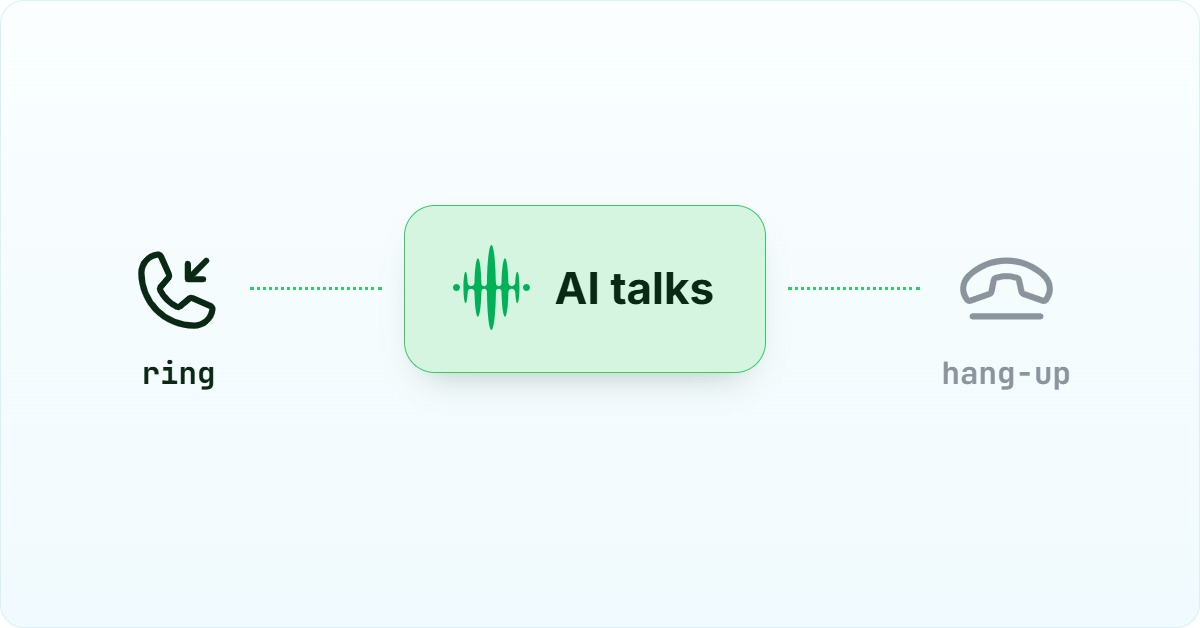
Every call follows the same sequence, whether the agent is answering an inbound line or placing an outbound one. The table below walks through each stage, names who or what handles it, and flags where things can go wrong.
| Stage | What happens | Who or what handles it | What can go wrong |
|---|---|---|---|
| Call connects | The phone network routes the call to the platform | Carrier and phone layer | Call drops before the agent answers |
| Caller speaks | Audio is captured and sent to the speech-to-text engine | Phone layer and STT provider | Background noise causes a misread |
| Text is understood | The language model reads the transcript and decides a reply | LLM (large language model) | Ambiguous input produces an off-topic response |
| Reply is spoken | The text-to-speech engine converts the reply to audio | TTS provider | Unnatural pacing makes the caller uncomfortable |
| Caller interrupts | The system stops speaking and listens again | Phone layer and STT provider | Interruption is missed and the agent talks over the caller |
| Escalation needed | The agent transfers the call to a human | Phone layer and call routing | Transfer fails or context is lost |
| Call ends | Recording is saved and a summary is generated | Platform and storage | Recording is incomplete or not retained per policy |
The table shows that most failures happen at the edges: the moment the call connects, the moment someone interrupts, and the moment a transfer is needed.
Two things callers notice most. First, the pause between when they finish speaking and when the agent starts replying. In a well-built system this is under a second, which feels natural. In a poorly built one it stretches to two or three seconds, which feels broken. Second, what happens when they interrupt. A good system stops mid-sentence and listens, the way a person would. A poor one finishes its sentence regardless, which frustrates callers quickly.
Underneath all of this sits a phone layer: a platform that holds the audio connection open, moves the audio between the phone network and the AI systems, and handles the call controls like hold, transfer, and hang-up. Teams building an AI voice agent do not build this layer themselves. They connect to a provider that runs it, the same way they connect to a payment processor rather than building card processing from scratch.
What does it cost to run an AI voice agent?
Cost splits across two separate bills, and the split is what surprises most teams. The table below names each line, who charges it, and what drives it up.
| Cost line | Who charges it | What makes it rise |
|---|---|---|
| Phone capacity (simultaneous calls) | Phone layer provider | More calls happening at the same time |
| Per-minute call charges | Phone layer provider | Higher call volume and longer conversations |
| Phone number rental | Phone layer provider | More active numbers |
| Call recording and storage | Phone layer or platform provider | Higher call volume and longer retention periods |
| Speech-to-text usage | STT provider | More audio minutes processed |
| Language model usage | LLM provider | More turns per call and longer conversations |
| Text-to-speech usage | TTS provider | More audio generated per call |
| Setup and scripting labor | Internal team or systems integrator | Complexity, rework, and compliance review |
The distinction that catches teams off guard is that phone capacity is charged by how many calls run at the same time, while AI model costs are charged by how much is said. A campaign that sends 500 calls at once needs 500 simultaneous channels, even if each call is short. A campaign that sends 50 calls but each one runs for ten minutes generates a large AI bill even though the channel count is low. Both lines need to be modelled before the first campaign goes out.
Hidden costs that rarely appear in the initial estimate include: rewriting the script and the instructions to the language model, which one practitioner described as running into the hundreds of iterations before the tone and escalation logic felt right; human review of call transcripts for quality and compliance; handling calls that the agent could not complete; delays in getting phone numbers provisioned; and the internal legal and operations work of meeting consent and registration requirements before the first outbound call.
For current Teler pricing, check current Teler pricing. For other providers, check their pricing pages directly and model both the phone and AI lines before committing to a volume.
Teams budget for the AI and forget that phone capacity is charged by how many calls run at once, so the first busy Monday doubles a line they never modelled.
– Subhash Kalluri, Founder & CEO, FreJun
What does it take to set up an AI voice agent?
Setup has two sides: what the business supplies and what the platform supplies. Mixing them up is where projects stall.
The business supplies: the phone number or numbers, the script and the goals for each call type, access to whatever systems the agent needs to read or write (a CRM, which is a customer relationship management system, a calendar, an order system, or a ticketing tool), a person to review early calls and flag where the agent goes wrong, and the consent records required by law before any outbound campaign starts. None of these come from the platform.
The platform supplies: the phone infrastructure, the connection to the speech and language models the team chooses, the call controls, and the recording and logging. FreJun Teler, for example, connects to any speech-to-text, language, or text-to-speech provider the team selects, with no lock-in to a single model vendor. The platform also provides phone numbers in more than 50 countries, call transfer to a human, hold, hang-up, and recording controls.
Systems the agent needs to connect to
For most use cases, the agent needs to read from at least one external system during the call. An appointment reminder agent needs a calendar. A lead qualification agent needs a CRM. A customer support agent needs an order or ticketing system. The integration work for these connections is usually the longest part of the project, and it sits entirely with the business or its developer, not with the phone platform. Plan for it before the first demo.
On the build-versus-buy question: building the phone layer in-house is the right answer only when a team has specific carrier relationships, unusual audio routing requirements, or compliance constraints that no commercial platform can meet. For most businesses, the cost and time of building and maintaining phone infrastructure outweighs any advantage. The more common decision is which platform to use, not whether to use one. For teams who want to understand the integration in more detail, the Teler developer documentation covers how the phone layer connects to AI models.
What rules apply to AI voice agents in the US?
This section describes the federal rules as of September 2026. It is not legal advice. The obligations below sit with the business placing or receiving the calls, not with the phone platform.
| What the rule requires | Who it applies to | Who is responsible | Source |
|---|---|---|---|
| Prior express consent before placing a call that uses an AI-generated voice to a covered number | Any caller using AI-generated voice on outbound calls | The business placing the call | FCC TCPA declaratory ruling, February 2024 |
| Identification and disclosure in artificial or prerecorded voice messages | Any caller using AI-generated or prerecorded voice | The business placing the call | FCC declaratory ruling, FCC 24-17, February 2024 |
| Prior signed written agreement from the consumer before placing a prerecorded telemarketing call | Sellers and telemarketers using prerecorded messages for outbound telemarketing | The seller or telemarketer | FTC Telemarketing Sales Rule, 16 CFR Part 310 |
| Opt-out mechanism in every prerecorded telemarketing call, working for live answers and voicemail | Any telemarketer delivering a prerecorded message | The telemarketer or seller | FTC opt-out rule, effective December 2008 |
| Check and honor the National Do Not Call Registry before placing telemarketing calls | Sellers and telemarketers | The seller or telemarketer | FTC Q&A on DNC provisions in the TSR |
The table shows that every consent and registration obligation sits with the business, not with the platform. Using a commercial phone layer does not transfer these duties.
The key shift in the last two years is the FCC’s February 2024 declaratory ruling, which confirmed that AI-generated voices are treated as artificial or prerecorded voice under the TCPA (Telephone Consumer Protection Act, the 1991 federal law that governs automated calls). That ruling closed a gap some businesses had assumed existed: there is no separate, lighter standard for AI-generated speech. The consent requirement is the same as for a traditional robocall. Before any outbound campaign using an AI voice agent, the business must have prior written consent from each recipient, must disclose the automated nature of the call, and must honor opt-outs immediately.
What goes wrong with AI voice agents after launch?
Most problems fall into three categories: conversation quality, integration gaps, and compliance failures. The table below names the common ones, why they happen, and what to do.
| Problem | Why it happens | What to do |
|---|---|---|
| Agent gives off-topic or wrong replies | The instructions to the language model are too vague or do not cover the scenario | Review transcripts of failed calls and rewrite the instructions; expect many iterations |
| Caller hangs up before the agent finishes speaking | The agent does not stop when interrupted, or the reply is too long | Test interruption handling before launch; shorten replies |
| Transfer to a human loses the context of the call | The platform does not pass a summary to the receiving agent | Build a handover summary into the transfer flow |
| Outbound campaign is blocked at the network level | Suspicious calling patterns trigger carrier filters | Spread call volume, use registered numbers, and check FCC telemarketing guidance |
| Consent records are missing before the campaign starts | The team assumed the platform handles compliance | Collect and store written consent before the first call; the obligation sits with the business |
| Integration with CRM or calendar fails mid-call | The external system is slow or the connection was not tested under load | Test integrations with realistic call volumes before launch |
The most consistent finding from practitioners is that the script and the instructions to the language model need far more iteration than teams expect, often running into the hundreds of rewrites before tone, pacing, and escalation logic feel right. That is not a platform problem; it is the work of the project.
When should you not use an AI voice agent?
An AI voice agent is the wrong tool in several specific situations, and being clear about them saves a project from a bad outcome.
Call volume is too low to justify the setup. If a business handles fewer than a few dozen calls a day, the time spent building, testing, and maintaining the agent will not pay back in staff time saved. A human answering the phone is faster to deploy and easier to adjust.
The conversation is too sensitive or complex. AI voice agents work well for straightforward tasks: scheduling appointments, answering common questions, directing calls, and summarizing discussions. They are not suited to conversations that require judgment about a person’s emotional state, negotiations, or situations where a wrong answer causes real harm. A caller in distress, a complaint that could escalate to a legal matter, or a medical triage call should reach a person.
A licensed person is legally required. Some regulated interactions, including certain financial advice calls, clinical consultations, and legal guidance, require a licensed human. No automation changes that obligation.
The customer base rejects automation. Some customer segments, particularly older callers or those in high-trust relationships with a business, will hang up the moment they realize they are not speaking to a person. If the business knows this about its callers, the cost of lost calls and damaged relationships outweighs the savings from automation.
Frequently asked questions
What is the best way to start with an AI voice agent for my business?
Start with one call type that has high volume, a predictable script, and low stakes if the agent gets it wrong. Appointment reminders and inbound FAQ calls are the most common starting points. Connect a phone platform like FreJun Teler, choose your speech and language models, and run the agent on a small share of real calls before expanding. Expect to rewrite the instructions many times before the conversation quality feels right.
How much does an AI voice agent cost to run?
Cost runs across two separate bills: the phone layer (capacity, per-minute charges, number rental, and recording) and the AI models (speech-to-text, language model, and text-to-speech). Both scale with call volume, but phone capacity scales with how many calls run at the same time, while AI costs scale with how much is said. Model both before your first campaign. For current figures, check current Teler pricing and the pricing pages of your chosen AI model providers.
What law governs AI voice calls in the US, and what does it require?
The TCPA (Telephone Consumer Protection Act) governs automated voice calls. In February 2024, the FCC confirmed that AI-generated voices are treated as artificial or prerecorded voice under the TCPA, so prior express consent is required before placing covered outbound calls. The FTC’s Telemarketing Sales Rule adds a written consent requirement for prerecorded telemarketing calls and requires an opt-out mechanism in every such call. The National Do Not Call Registry must be checked before any telemarketing campaign.
Will callers know they are not speaking to a person, and does that matter?
In short calls with a clear purpose, many callers cannot tell the difference. In longer or more complex conversations, most can. Whether it matters depends on the call type and the customer base. The FCC requires disclosure that a call uses an artificial or prerecorded voice, so the question of whether to disclose is settled by law. The question of how to disclose it in a way that does not immediately end the call is a design decision worth testing.
Should we build the phone layer ourselves or use a platform?
Building in-house is right only when a team has specific carrier relationships or compliance constraints that no commercial platform can meet. For most businesses, the cost and time of building and maintaining phone infrastructure outweighs any advantage. Platforms like Teler handle the phone network, carrier connections, and call controls, so the team can focus on the conversation design and the integrations. The Teler documentation covers how the connection to AI models works.
What happens when the agent does not understand what someone said?
A well-designed agent asks a clarifying question once, then offers to transfer to a human if it still cannot help. The transfer should pass a summary of the call so the human does not ask the caller to repeat everything. If the agent has no transfer option and cannot understand the caller, the call ends badly. Building a clear escalation path is not optional; it is the part of the design that protects the customer relationship.
How long does it take to go from decision to live calls?
A simple inbound agent with a clear script and no external integrations can be live in days. An outbound campaign with CRM integration, consent collection, and compliance review takes weeks, sometimes longer if number provisioning or legal review creates delays. The script and instruction work is the part most teams underestimate. One practitioner reported rewriting the instructions hundreds of times over eight months before the agent performed consistently.
How is the AI voice agent category changing in 2026?
The biggest shift is regulatory clarity. The FCC’s 2024 ruling removed the ambiguity about whether AI-generated voices were covered by the TCPA. That clarity pushed compliance from a future concern to a present requirement, which changed how businesses plan outbound campaigns. On the technology side, the gap between a demo and a production-quality conversation has narrowed, but the work of tuning the agent to a specific business context remains substantial and is not automated away by better models alone.
Is an AI voice agent right for your business?
An AI voice agent is a practical tool for businesses with predictable, high-volume phone conversations and the operational discipline to manage consent, script quality, and escalation design. The decision to deploy one is not primarily a technology decision; it is a decision about which calls are worth automating and whether the business can meet the legal requirements before the first outbound call goes out.
For teams ready to build, FreJun Teler provides the phone layer that connects an AI voice agent to live calls, with phone numbers in more than 50 countries and support for any speech or language model the team chooses. For teams still evaluating, the right first step is mapping the call types, the consent records already held, and the systems the agent would need to read, before choosing any platform. If the call volume is low, the conversations are sensitive, or the customer base is likely to reject automation, keeping a human on the line is the better answer. You can also explore the top AI voice agent platforms in the US and read about how to deploy an AI voice agent for inbound call handling to go deeper on the implementation side.